Gobos and prisms are the two effects that turn a moving head from a coloured light into something that draws on the room. They are also the two most often bought speculatively and then never used, because nobody worked out what job they were meant to do.
The short answer
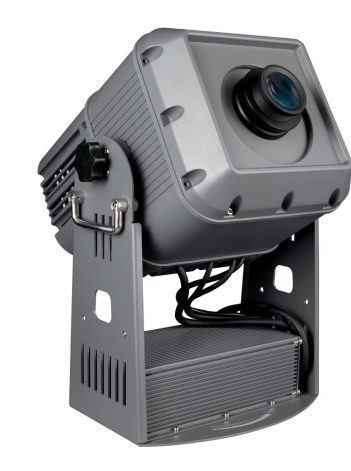
A gobo puts a shape in the beam — a pattern, a logo, a break-up that makes a flat wash look like light through trees. A prism multiplies the beam into a cluster. Buy gobos when you need an image or texture on a surface, and prisms when you need to fill air. If the pattern needs to sit in one place for months, use a dedicated projector instead of a moving head: it is brighter per dollar and it takes your own artwork.
What does a gobo actually do?
A gobo is a stencil in the optical path. Metal gobos are cut sheet and give hard-edged geometric patterns; glass gobos are printed or etched and carry photographs, logos and gradients. Placed in the beam, the fixture projects that image at whatever it is pointed at.
Two things decide whether the result looks professional: the quality of the gobo and the evenness of the beam behind it. A glass gobo in a fixture with a hot centre will show the hot centre, which is why gobo work favours profile and spot fixtures over washes.
| Gobo type | What it projects | Best for | Limitation |
|---|---|---|---|
| Metal, fixed | Geometric patterns, hard edges | Break-ups, texture on a wall | No photographic detail |
| Glass, fixed | Logos, photographs, gradients | Branding, architectural projection | Costs more, can fade with heat |
| Glass, rotating | The same, spinning | Movement in a projected image | Needs a rotating wheel |
| Indexing / scrolling | Several gobos selectable | One fixture doing several looks | More channels, more cost |
When should you use a dedicated gobo projector instead of a moving head?
When the image does not move. A logo on a lobby wall, a company name on a show floor, a pattern on a building facade — these are installations, and a moving head spends money on motors and a yoke that will never turn.
A dedicated projector puts the entire budget into output and optics. Our indoor units start at US$36 and the outdoor range at US$58, against several hundred dollars for a moving head with a gobo wheel.
| Model | Type | EXW, 1 unit |
|---|---|---|
| RG-PJ12-S | 12W Cree LED, indoor, static or rotating | US$36 |
| RG-PJ20-S | 20W Cree LED, indoor | US$50 |
| RG-W40IB1-Kf40A | RGBW 3D dynamic water pattern | US$45 |
| RG-GB30L0C1-BK | IP65 30W outdoor water wave | US$58 |
| RG-PJ30-indoor | 30W Cree LED, indoor rotating | US$63.5 |
| RG-PJ30-Multi-Indoor | 30W multi-pattern, DMX512 | US$152 |
| RG-PJ80-indoor | 80W Cree LED, indoor rotating | US$135 |
| RG-PJ100-Outdoor | 100W Cree LED, outdoor rotating | US$199 |
The water-pattern units are the ones that surprise people. RG-W40IB1-Kf40A projects a moving ripple across a ceiling or wall, and it is the cheapest way to make a flat surface look alive — considerably cheaper than the lighting it replaces.
How much projector do you need outdoors?
Outdoor projection is where gobos earn their keep, because a large pattern on a facade is visible from a long way off and costs one fixture. The constraint is ambient light: a projector that is obvious at dusk disappears under street lighting.
| Model | Power | Rating | EXW, 1 unit |
|---|---|---|---|
| RG-GB30L0C1-BK | 30W | IP65 | US$58 |
| RG-PJ30-Outdoor | 30W | Outdoor rotating | US$99 |
| RG-PJ80LE8R1Y1-BK | 80W | IP65 rotating | US$115 |
| RG-PJ100-Outdoor | 100W | Outdoor rotating | US$199 |
| RG-GB300L4C0-WK | 300W | IP65 gobo and water | US$250 |
| RG-GB400L6C0-ZK | 400W | IP65 logo projector | US$465 |
| RG-GB500L4C0-BK | 500W | IP65 logo projector | US$593 |
| RG-GB750L4C0-BK | 750W | IP65 logo projector | US$885 |
The step from 30W to 300W is the difference between a pattern that reads after dark and one that survives a lit street. RG-GB300L4C0-WK is the point where outdoor projection becomes a practical advertising medium rather than an effect, and it still costs less than a single mid-range moving head.
For permanent architectural work the 400W to 750W units are the real answer; they are priced against the signage they replace, not against the lighting they sit next to.
What is a prism for?
A prism splits one beam into several. A three-facet prism gives three beams in a ring, an eight-facet gives eight, and a linear prism fans them into a line. Rotating the prism makes the cluster sweep, which is the effect that fills a large room from a handful of fixtures.
| Prism type | What the audience sees | Typical use |
|---|---|---|
| 3-facet circular | Three beams rotating around a centre | Slow sweeps, elegant rather than busy |
| 8-facet circular | Eight beams in a ring | Big aerial fan effects at speed |
| Linear (6-row) | A fan or curtain of beams | Walls of light across an audience |
| Prism + gobo | Patterned copies of the same image | Texture multiplied across a surface |
Prisms need air. Like beams, they are an aerial effect: with no haze and a low ceiling, an eight-facet prism produces eight bright dots on the back wall and nothing else.
Which moving heads carry gobos and prisms worth using?
Gobo wheels are standard on spot and hybrid fixtures; prisms are common on beams. The useful specification is not whether the fixture has them but how many are on the wheel and whether the wheel rotates.
| Model | Type | Effects | EXW, 1 unit |
|---|---|---|---|
| RG-ML380BN-KYH17 | 380W beam | Prism | US$259 |
| RG-ML300BR-KN1H17 | 300W 3-in-1 BSW | Gobo wheel and prism | US$315 |
| RG-M250S-KNH20 | 250W 8R spot | Gobo wheel and prism | US$318 |
| RG-ML250BR-KN1H18 | 250W LED zoom 3-in-1 | Gobo wheel and prism | US$359 |
| RG-ML400RS-KNNW1H21 | 400W CMY 3-in-1 BSW | Rotating gobos, prism, CMY | US$459 |
| RG-ML500RS-KNNW1H20 | 500W CMY 3-in-1 BSW | Rotating gobos, prism, CMY | US$569 |
The 3-in-1 BSW units are the practical answer for most rigs, because the same fixture can throw a pattern as a spot and then open into a wash without changing anything in the rig. RG-ML300BR-KN1H17 is the cheapest unit in our range that does all three with a gobo wheel behind it.
What should you not do with them?
Do not buy a gobo wheel for a rig that will only ever wash. Do not put a prism on a fixture hung at 3 m. And do not order a metal gobo when the artwork has a gradient or a photograph in it — it will not reproduce, and the money is wasted on a stencil that cannot carry the image.
Send us the artwork and the surface it needs to land on, and we will size the projector and tell you whether a glass or metal gobo will hold the detail.
Frequently Asked Questions
What is the difference between a gobo and a prism?
A gobo is a physical or glass pattern placed in the beam, so the fixture projects that shape. A prism is an optic placed after the beam that splits it into three, five or more copies arranged in a ring or a fan. A gobo changes what the beam looks like; a prism changes how many beams there are.
Do I need a dedicated gobo projector or will a moving head do?
A moving head gobo wheel is the right choice when the pattern needs to move, change or rotate during a show. A dedicated projector is better when the same image stays in one place for months — a logo on a wall, a company name on a floor — because it is cheaper per unit of brightness and can be fitted with your own artwork.
How bright does a gobo projector need to be?
Match it to the surface, not the room. A logo on a dark matte wall in a lit lobby needs 100W or more; the same logo on a white wall in a dark room is legible from a 30W unit. Glass gobos hold detail better than metal ones at any power.
Can a gobo be used outdoors?
Yes, if the projector is IP65. Outdoor projection is one of the strongest uses of gobos, because a pattern on a building facade or a pathway is visible from far away. Our outdoor units start at US$58 for a 30W water-effect projector.
What is a prism actually good for?
Filling space. A three-facet or eight-facet prism turns one beam into a cluster that sweeps the audience, which is how a handful of fixtures makes a large room feel busy. It is an aerial effect and needs haze and height to read.
Need help choosing fixtures for your project? Tell us the venue type and room size — we'll spec it for free.
Request a Free Rig Spec →