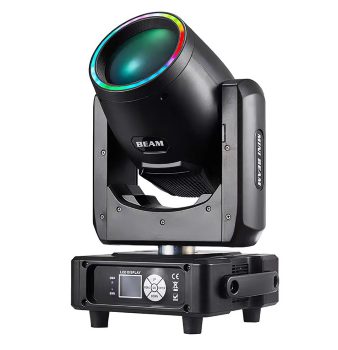
The LED engine is almost never the part that fails. That surprises buyers, because every fixture is sold on LED life, and it matters because the parts that do fail are cheap, replaceable, and worth asking about before an order rather than after.
The short answer
Expect the LED to outlast everything around it. Budget for fans, belts and driver boards instead, stock one spare fixture per ten units, and make spare-part availability a condition of the order. Ask the supplier six specific questions before paying a deposit — the answers tell you more about the real cost of ownership than any specification sheet.
What actually fails, and when?
Heat and movement. Both are unavoidable in a moving head, and both concentrate on the parts that are easiest to overlook.
| Component | Typical failure mode | Why it happens | Replaceable? |
|---|---|---|---|
| Cooling fan | Bearing seizes, airflow stops | Runs continuously, pulls dust through the housing | Yes, cheap |
| Drive belt | Stretches or snaps | Constant pan/tilt movement under load | Yes, cheap |
| Stepper motor | Loses steps, position drifts | Heat plus mechanical shock from transport | Yes, moderate cost |
| Driver capacitors | Dimming becomes unstable | Heat is the enemy of electrolytic capacitors | Board-level repair |
| LED engine | Gradual output loss | Typically the longest-lived part | Sometimes field-replaceable |
| Optics | Haze, delamination on glass | Heat and UV on coated surfaces | Rarely worth it |
The pattern is that everything on the list is heat-related. A fixture kept clean and cool outlives the same fixture run hot in a dusty ceiling void by years, which is why maintenance does more for lifespan than specification.
Is it worth repairing or replacing?
It depends on where the fixture sits in the price ladder, because the repair cost is roughly constant while the replacement cost is not.
| Fixture price band | Repair worth it? | Typical approach |
|---|---|---|
| Under US$150 | Only for a fan or belt | Swap the faulty unit for a spare, repair in a batch |
| US$150–US$260 | Yes, for any single-part failure | Repair; part cost is a small fraction of replacement |
| US$260–US$500 | Yes, almost always | Repair, including board-level work |
| US$500+ | Yes, and plan for it | Repair; consider a service agreement |
Our sub-US$100 moving heads — RG-ML70WS-KNNe7AH8 and RG-ML54WS-KEDf18AH12 — are the units where a fan swap is worth doing and a board failure is not. At the other end, a 500W CMY hybrid is worth repairing at almost any fault, because the replacement cost is several hundred dollars.
Which spare parts should be stocked?
Stock by family, not by fixture. Standardising on one chassis per price tier means one spare-part bin covers most of the rig.
| Spare | How many | Covers |
|---|---|---|
| Fan, per fixture family | 2 per 10 units | The most common failure by far |
| Belt set, per family | 1 per 10 units | Pan/tilt drive on nightly fixtures |
| Power supply, per family | 1 per 20 units | The failure that takes a fixture out instantly |
| Complete spare fixture | 1 per 10 units | Weekend cover while a repair happens |
| Lenses / yoke covers | 1 per 20 units | Transport damage |
| Gobos | Per design | Fixtures running a custom pattern |
| Fleet size | Spare fixtures | Fan stock | PSU stock |
|---|---|---|---|
| 10 | 1 | 2 | 1 |
| 20 | 2 | 4 | 1 |
| 40 | 4 | 8 | 2 |
| 60 | 6 | 12 | 3 |
The spare-fixture ratio is the same one rental houses use, and it applies to fixed installations for a different reason: a venue that loses a fixture on a Friday cannot wait for a part.
What six questions should you ask a supplier?
These six answers predict the cost of ownership better than any specification.
| Question | Why it matters | A weak answer |
|---|---|---|
| How long are spare parts guaranteed available? | Determines whether a repair is possible at all | "We will try" |
| What are the warranty terms, in writing? | Verbal assurances do not survive a claim | A number with no scope |
| Is the LED engine field-replaceable? | Turns a dead fixture into a parts swap | "It is sealed" |
| What fan is fitted, and is it a stock size? | A proprietary fan means a proprietary repair | No specification given |
| What does the service documentation cover? | Decides whether in-house repair is realistic | "Contact us" |
| Can a sample be tested before the production order? | The only real check on any of the above | Sample refused |
The last question is the one that separates a supplier with confidence from one without it. A production order placed without testing a sample is a bet on every claim in the quotation.
What should a maintenance schedule look like?
Little and often. Most of the work is cleaning, and cleaning is what protects the fans.
| Interval | Task | Why |
|---|---|---|
| Monthly | Vacuum intake filters and fan grilles | Dust is what kills fans and capacitors |
| Quarterly | Check pan/tilt belts for slack and wear | A snapped belt is a lost position mid-show |
| Quarterly | Verify every fixture still parks where it was focused | Position drift is the visible symptom of motor wear |
| Annually | Clean optics, check connector seating | Haze on optics costs output you have already paid for |
| Annually | Re-run the DMX addressing audit | Fixtures get swapped and the plan drifts |
Does buying in quantity help with spares?
Yes, twice. Volume pricing frees budget for a spare stock, and a single order of one model means one part number for every unit in that tier.
| Model | 1 unit | Volume price | Threshold | Saving |
|---|---|---|---|---|
| RG-ML240WD-KTXe6AH3 | US$192 | US$162 | Over 30 pcs | 15.6% |
| RG-EL00DB-8e2A | US$259 | US$219 | Over 30 pcs | 15.4% |
| RG-ML400BR-KCRe10AH49 | US$199 | US$186 | Over 30 pcs | 6.5% |
| RG-ML125BL-KCRe38AH274 | US$155 | US$148 | Over 30 pcs | 4.5% |
| RG-ML300BR-KN1H17 | US$315 | US$300 | Over 20 pcs | 4.8% |
A thirty-unit order of the zoom pixel bar saves enough against the single-unit price to buy two spare fixtures outright. That is the practical argument for buying the spare stock at the same time as the order rather than a year later.
What to send us
Tell us the models you are running, how many, and how many nights a week. We will quote spare-part kits by family and tell you which parts are stocked items and which have to be ordered.
Frequently Asked Questions
How long does an LED moving head last?
The LED engine is usually the last thing to go — rated lives are typically tens of thousands of hours. What ends a fixture's service life earlier is a fan bearing, a drive belt, a stepper motor or an electrolytic capacitor in the driver, all of which are moving or heat-stressed parts.
What fails first on a moving head?
Fans, in practice. They run continuously, they pull dust through the housing, and a seized fan cooks the driver board. The second most common failure is a belt or a pan/tilt motor on fixtures that move hard every night.
Is it worth repairing a cheap moving head?
Below about US$150 per unit, usually not, unless the failure is a fan or a belt. Above US$250, repair is almost always cheaper than replacement, provided the spare part is available. Ask about part availability before you buy, not after.
Which spare parts should a venue stock?
Fans, belts and a power supply for each fixture family in the rig, plus one complete spare fixture per ten units. Gobos, lenses and yoke covers are worth holding for fixtures that move nightly.
What should I ask a supplier before ordering?
Six things: spare-part availability and for how long, the warranty terms in writing, whether the LED engine is field-replaceable, the fan specification, what the service documentation covers, and whether a sample can be tested before the production order.
Need help choosing fixtures for your project? Tell us the venue type and room size — we'll spec it for free.
Request a Free Rig Spec →