The first ten fixtures are a shopping list. The next fifty are an inventory, and they behave differently: some units earn their keep every week, some sit in cases for a month, and the difference between the two is the only number that should drive the next purchase.
The short answer
Grow a rental fleet in tiers, not one fixture at a time. Fill the middle tier first — the US$150 to US$220 units that cover the most requests per dollar — then add depth to whichever tier is booking out. Carry roughly ten percent spares once the fleet passes twenty units, buy in quantity to reach the published volume tier, and add IP65 or CMY only when a specific job you have already quoted asks for it.
What breaks when a fleet grows past ten fixtures?
Three things stop working at once, and most rental houses notice them in this order.
| What breaks | Symptom | The fix |
|---|---|---|
| Utilisation | Half the fleet sits idle while a few units are always out | Track which tier books out; buy depth there |
| Standardisation | Four fixture families, four menu structures, four spare-part bins | Consolidate onto one chassis family per tier |
| Failure rate | A dead fixture is now a lost job, not an inconvenience | A spare ratio of about 10% |
| Case logistics | Mixed fixture sizes mean the truck never packs efficiently | Buy to a case size, not to a fixture count |
The utilisation problem is the one that costs the most money, because it is invisible. Below ten fixtures, every job uses everything you own and every purchase looks justified. At forty fixtures, the units booking out every week are subsidising the ones that go out twice a year, and the only way to see which is which is to log it.
How should the fleet be tiered?
Three tiers covering cheap volume work, the working middle, and the premium units that justify a higher day rate.
| Tier | Price band | Role in the fleet | Target share |
|---|---|---|---|
| Volume | Under US$150 | Corporate work, small gigs, dry hire | 30% |
| Workhorse | US$150–US$260 | The bulk of every job | 50% |
| Premium | US$260+ | Broadcast, tours, anything with a rider | 20% |
The middle tier is where a fleet should be deepest. Those units cover the widest range of requests per dollar, they are cheap enough to buy in quantity, and they are still good enough to put on a rider.
| Model | Tier | Configuration | EXW, 1 unit |
|---|---|---|---|
| RG-ML125BL-KCRe38AH274 | Volume | 38 × 3W, infinite rotation | US$155 |
| RG-ML216WD-KTXf72AH12 | Volume | 72 × 3W RGB wash | US$149 |
| RG-ML360WD-KTXe36AH12 | Workhorse | 36 × 10W 4-in-1 wash | US$139 |
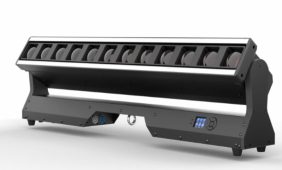
| RG-ML240WD-KTXe6AH3 | Workhorse | 6 × 40W zoom pixel bar | US$192 |
| RG-ML400BR-KCRe10AH49 | Workhorse | 10 × 40W RGBW pixel | US$199 |
| RG-ML300BR-KN1H17 | Premium | 300W 3-in-1 BSW | US$315 |
| RG-ML500BL-KCRe12AH194 | Premium | 12 × 40W zoom with strip | US$325 |
| RG-ML400RS-KNNW1H21 | Premium | 400W CMY 3-in-1 BSW | US$459 |
The zoom pixel bar is the most useful single unit in the workhorse tier: it does wash, beam and pixel effects, and it hangs from one clamp, which matters when the crew is small.
How much does buying in quantity save?
Between 3 and 16 percent, and the tiers are published rather than negotiated. That is unusual and worth using, because it means the saving is known before you ask.
| Model | 1 unit | Volume price | Threshold | Saving |
|---|---|---|---|---|
| RG-ML240WD-KTXe6AH3 | US$192 | US$162 | Over 30 pcs | 15.6% |
| RG-EL00DB-8e2A | US$259 | US$219 | Over 30 pcs | 15.4% |
| RG-ML400BR-KCRe10AH49 | US$199 | US$186 | Over 30 pcs | 6.5% |
| RG-ML340WC-KCH37 | US$185 | US$175 | Over 20 pcs | 5.4% |
| RG-ML300B-KCRe5AH105 | US$386 | US$365 | Over 30 pcs | 5.4% |
| RG-ML300BR-KN1H17 | US$315 | US$300 | Over 20 pcs | 4.8% |
| RG-ML500BL-KCRe12AH194 | US$325 | US$290 | Over 50 pcs | 10.8% |
| RG-ML760WC-KCH99 | US$560 | US$530 | Over 20 pcs | 5.4% |
Two things stand out. The largest discounts sit on the units that are already the best sellers, so the saving and the utilisation case point the same way. And the threshold is 20 to 50 pieces — which is exactly the point where a fleet is big enough to be planned rather than improvised.
How many spares should the fleet carry?
Roughly ten percent, rounded up, once the fleet is over twenty units. Below that, two spares is usually enough, because a failure can be covered by pulling a fixture from a non-critical position.
| Fleet size | Working units | Spares to hold | Why |
|---|---|---|---|
| 10 | 10 | 1 | Low failure probability; swap from a rear position |
| 20 | 20 | 2 | Two covers a Saturday with one failure |
| 40 | 40 | 4 | Ten percent is the standard ratio |
| 60+ | 60 | 6–8 | Add a spare per ten units on the workhorse tier only |
Spares only need to cover the workhorse tier. A premium fixture going down the day before a load-out is a phone call to another rental house; a workhorse going down is the difference between shipping the job and not.
When should the fleet add IP65 or CMY?
When a quoted job asks for it, not before. Both roughly double the cost of a position, and both sit idle unless the work is genuinely there.
| Upgrade | Rough cost multiplier | Add it when |
|---|---|---|
| IP65 weatherproofing | ~2× | You turn down outdoor work more than twice a season |
| CMY colour mixing | ~1.4× | Broadcast or touring riders specify it |
| Zoom | ~1.3× | Trim height changes between jobs — usually worth it immediately |
Zoom is the exception. It costs about 30 percent more and removes the constraint that otherwise forces two different wash angles into the inventory, so it pays for itself in fixture count rather than in day rate.
Our IP65 moving heads — the 230W outdoor beam and the IP65 zoom wash — are the two units rental houses add first, because they cover the two outdoor requests that come up most: an aerial beam for a festival stage and a wash for a courtyard or marquee.
What should the fleet not buy next?
More variety. The instinct at forty fixtures is to add a fourth family to cover a request that came up once. That adds a spare-part bin, a case size and a menu structure for one job a year. Sub-hire that job and buy more of what is already booking out.
Send us your fleet size, the tier that is booking out, and the job you had to turn down last, and we will price the next order at the volume tier that applies.
Frequently Asked Questions
What changes once a rental fleet passes ten fixtures?
Three things: utilisation becomes measurable, standardisation starts saving real money, and the fleet needs a spare ratio. Below ten fixtures every job uses everything you own. Above it, some fixtures sit idle and you can see which ones earn their keep.
How many spares should a rental house carry?
About ten percent, rounded up, once the fleet is over twenty units. A fleet of 40 working fixtures wants four spares. Below twenty, two spares covers it, because the failure probability is low enough that a swap from a non-critical position works.
Does buying in quantity actually save money?
Between 3 and 16 percent depending on the model, and the discount is published rather than negotiated. Our volume tiers start at 20 to 50 units and are listed on each product page, so the saving is known before you ask.
Should a rental fleet be standardised on one fixture?
On one family, not one model. Standardising on a single chassis means one set of spare parts, one set of flight cases and one menu structure to learn, while still covering wash, beam and hybrid duties from the same platform.
When is it worth adding IP65 fixtures to a rental fleet?
When you turn down outdoor work more than twice a season. IP65 units cost roughly twice the indoor equivalent, so the break-even is a handful of booked outdoor jobs per year, not a hypothetical one.
Need help choosing fixtures for your project? Tell us the venue type and room size — we'll spec it for free.
Request a Free Rig Spec →