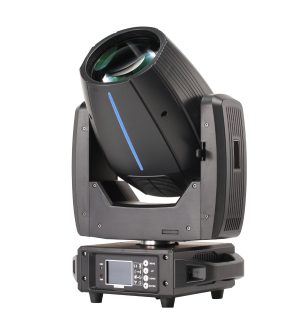
A sanctuary is the hardest room in lighting to get right, because the audience is sitting still, facing one direction, and needs to see faces — and because the same room has to support a spoken reading and a full band without changing anything.
The short answer
Front light from white fixtures angled down onto the platform, movement and colour on the architecture. Keep every beam above the sightlines, use wide angles for coverage and narrow ones only for texture on a wall, and specify quiet fixtures — a fan that vanishes in a band set is clearly audible during a reading. Four to six moving heads plus a proper white front-light system covers most sanctuaries.
Why do sanctuary rigs blind people?
Because the beam path crosses the room at eye level. A fixture hung low at the back of a sanctuary, aimed at the platform, puts its beam through the heads of everyone in the back half of the room.
| Problem | Cause | Fix |
|---|---|---|
| Beams in the eyes | Fixture hung at or below audience head height | Hang above the sightline and angle down |
| Hot spots on faces | Narrow beam used as front light | Wide wash, or a Fresnel with a soft edge |
| Uneven platform | Too few fixtures, too narrow an angle | One wash per 1.5–2 m of platform width |
| Colour on skin | RGB wash aimed at people | Keep colour on walls and structure |
| Visible fan noise | Noisy fixtures near microphones | Specify dB(A) at 1 m; hang loud units high and far |
| Distraction during a reading | Movement running when nothing is happening | Park or fade the movers; movement is punctuation |
The rule that solves most of it: any beam that crosses the congregation has to be above their heads. Draw the sightline from the highest seated eye position to the platform, and hang everything above that line.
What should carry the front light?
Dedicated white fixtures, not moving heads. Front light is the least glamorous and most used light in the room, it never needs to move, and a moving head spends money on motors that will never turn.
| Model | Type | Why it suits a sanctuary | EXW, 1 unit |
|---|---|---|---|
| RG-PS200A20T50-W | 200W LED Fresnel zoom | Tunable white, soft edge, zoom to fit the platform | US$95 |
| RG-PS150A110-Wg | 200W RGBWW 5-in-1 panel | Five-colour mixing, very smooth field | US$105 |
| RG-PS200A110-W | 200W tricolor soft light | Even soft field for a wide platform | US$115 |
| RG-PS120A170-W | 120W 256-LED panel | Cheap, even wash for a small platform | US$62 |
| RG-PS150A170-W | 150W embedded panel | Recessed look for a low ceiling | US$72 |
| RG-TH4B450 | 4 × 100W cool and warm white COB | Warm/cool balance control | US$95 |
| RG-TH2B250 | 2 × 100W cool and warm white | Smaller platform or a pulpit position | US$64 |
The 200W Fresnel zoom is the one to start with. Tunable white means the platform can be matched to the room, the soft edge means no hot spots on faces, and the zoom means the same fixture works whether the platform is 4 m or 8 m deep.
Where does movement belong?
On the architecture and the stage floor, not across the congregation.
| Use | Where | What to use |
|---|---|---|
| Texture on the back wall | Gobo or wide wash from above | A spot with a break-up gobo |
| Colour on structure | Uplight on columns, ceiling beams | Fixed RGBW PAR or wall washer |
| Movement during music | Sweeps above head height | Moving washes, 25°+ |
| Aerial beams | Only above 6 m and with haze | Beam fixtures, used sparingly |
| Stage floor specials | Downward pools | Zoom spot |
Movement is punctuation. A room where the fixtures are always moving looks restless during a reading and no more impressive during a song. The best sanctuary designs park the movers for most of a service and use them for three or four moments.
What should a sanctuary buy, and in what order?
White front light first, always. It is the difference between a platform that reads and one that does not, and it is the cheapest part of the system.
| Priority | Item | Typical count | Notes |
|---|---|---|---|
| 1 | White front light | 4–8 Fresnel or panel | The job nothing else does |
| 2 | Fixed colour wash | 6–10 RGBW PAR | Colour on walls and structure |
| 3 | Moving washes | 4–6 | Movement above the sightline |
| 4 | Gobo or texture | 2–4 | Back wall and ceiling texture |
| 5 | Beam fixtures | 0–4 | Only in a tall room, and only when used carefully |
| Model | Role | EXW, 1 unit |
|---|---|---|
| RG-P47IC8-Ke12A | Fixed RGBW PAR for wall colour | US$67 |
| RG-P56IC200-Ke1 | Fixed white or RGBW PAR | US$69 |
| RG-P57TC50-Kf4A | Fixed PAR, warm option | US$73 |
| RG-ML360WD-KTXe36AH12 | 36 × 10W moving wash | US$139 |
| RG-ML350WR-KOSe4H58 | 7 × 40W zoom moving wash | US$186 |
| RG-ML300BR-KN1H17 | 300W 3-in-1 BSW with gobo wheel | US$315 |
The zoom moving wash is the right first moving fixture for a sanctuary, because zoom lets one unit cover the platform from a close trim and the back wall from a wide one without refocusing.
What about the livestream?
The camera changes the priorities, usually in the same direction. A camera needs more light than an eye does, hates colour on skin, and sees fan noise as audio.
| Camera requirement | What it changes |
|---|---|
| Higher light levels | Brighter white front light than the room needs |
| No colour on faces | Keep RGB off the platform; white front light only |
| High CRI | White engines, not RGB mixed to white |
| Quiet | The same dB(A) requirement, for the microphones |
| No flicker | Test at the camera shutter speed before a service |
Designing for both at once is mostly a matter of doing the room version well and then adding output. A sanctuary that looks good to the eye and wrong on camera is nearly always one where the front light is too dim or too coloured.
What should be avoided outright?
Strobes and audience blinders during worship, narrow beams at low trim, colour on faces, and any fixture with a fan loud enough to hear during a reading. Everything else is a matter of taste.
Send us your platform width, ceiling height and seating layout, and we will size the front light and tell you where the moving fixtures can hang without putting a beam in anyone's eyes.
Frequently Asked Questions
How do you light a sanctuary without blinding the congregation?
Keep every beam above the sightlines. Nothing beams across the room at eye level, and no fixture is hung where a seated person is in the beam path. Front light comes from a high position angled down onto faces, while movement stays on walls, ceilings and the stage floor.
What beam angle suits a sanctuary?
Wide, for the most part. A 25 to 60 degree wash covers a platform evenly from a normal trim height, and a narrow beam has no business in a room where people are sitting still. Use narrow angles for texture on a back wall, never across the room.
How loud is too loud for a church fixture?
Quieter than you think. A fan that disappears in a band set is clearly audible during a spoken reading. Ask for the noise figure at one metre before buying, and hang the loudest fixtures furthest from the microphones.
Should a church use colour?
Yes, but on architecture rather than people. Colour on the back wall, the ceiling and the structure gives a room atmosphere; colour on faces makes skin tones unnatural and looks worse on the livestream than in the room.
How many moving heads does a typical sanctuary need?
Four to six for movement, plus a fixed white front-light system. Movement is an accent that supports a moment; the front light is what makes the platform visible and it should come from dedicated white fixtures.
Need help choosing fixtures for your project? Tell us the venue type and room size — we'll spec it for free.
Request a Free Rig Spec →