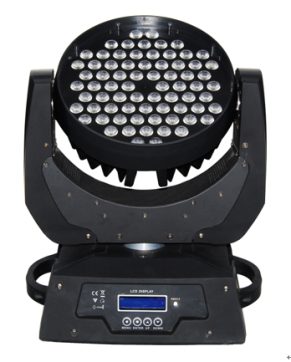
Zoom is the specification people read past, and it is the one that decides whether a fixture can do two jobs instead of one. A moving head that zooms from a tight spot to a stage-wide wash replaces a second fixture — and in a rig where truss positions are fixed, the ability to change beam angle without re-rigging is often worth more than extra output.
The short answer
Specify zoom by the two ends you actually need, in degrees, and check lux at your real throw distance for each. A 17-50 degree range covers a tight special and a full-stage wash from the same fixture; an automatic 28-70 degree range suits a front-of-house position. A fixed 19 degree or 26 degree unit is cheaper, brighter within its angle, and the right answer when the fixture only ever does one job.
What does beam angle actually do to brightness?
Beam angle is a concentration ratio, so it moves lux far more than it moves output. Halve the beam angle and the same light falls on roughly a quarter of the area, which quadruples illuminance. Double it and lux drops to about a quarter.
| Beam angle | Relative area at fixed distance | Relative lux |
|---|---|---|
| 10 degrees | 1x | 1x baseline |
| 20 degrees | 4x | 0.25x |
| 40 degrees | 16x | 0.06x |
| 60 degrees | 36x | 0.03x |
Read that together with the inverse-square rule: a fixture giving 10,000 lux at 5 m gives roughly 2,500 lux at 10 m. A supplier who quotes lux without quoting distance and beam angle has told you nothing you can act on.
Which zoom ranges are actually available?
These are real beam-angle specifications from our current range, with EXW prices:
| Model | Beam angle / zoom | Power | EXW, 1 unit |
|---|---|---|---|
| RG-PS180A17T50-RGBW | Manual zoom 17-50 degrees | 180W RGBW | US$248 |
| RG-PS200A25T50M-W | Manual zoom 25-50 degrees | 200W | US$223 |
| RG-PS175A28T70D-W | Auto zoom 28-70 degrees | 175W | US$220 |
| RG-PS200A19-W | Fixed 19 / 26 / 36 / 50 degrees | 200W | US$223 |
| RG-PS200A20T50-K | 200W imported LED | 200W | US$168 |
The pattern is worth noting: the manual 25-50 degree unit and the automatic 28-70 degree unit sit within three dollars of each other, because the cost is in the motor and the alignment work rather than in the range itself. If you want the automatic range, the price is not the obstacle.
Should I buy a wash with zoom instead of a fixed wash?
A zoom wash does two jobs — a tight break-up over a small stage and a full-room colour wash — from one truss position. Real examples from the moving-head range:
| Model | Configuration | Class | EXW, 1 unit | Volume |
|---|---|---|---|---|
| RG-ML285WD-KOSe19AH25 | 19x15W | Zoom wash | US$159 | US$149 over 20 pcs |
| RG-ML500BL-KCRe12AH194 | 12x40W | Zoom wash | US$325 | US$290 over 50 pcs |
| RG-ML720BL-KCRe12AH179 | 12x60W RGBW | Wave bar with zoom | US$470 | US$455 over 30 pcs |
| RG-ML760WC-KCH99 | 19x40W, IP65 | Outdoor zoom wash | US$560 | US$530 over 20 pcs |
The single-source fixtures above are the ones to choose when a clean edge matters; the multi-source array wins when you want even coverage and pixel-level effects. That distinction is more consequential than the zoom range for most purchases.
When is a fixed beam angle the better buy?
Buy fixed when the fixture has one job and always will. A narrow 19 degree unit on a front truss throwing a tight special across a 10 m room does not need to zoom, and the money saved per fixture multiplies across a quantity of twelve. The same logic applies to beam fixtures used as aerials: a fixed tight angle is exactly what you want and zoom mechanism is a maintenance item you never use.
The rule that keeps rigs honest: if you cannot name the second role a zoom fixture will perform, you are paying for a mechanism that will sit at one end of its range for the life of the fixture.
How do I use both ends well in one show?
Three practical habits separate a rig that uses its zoom from one that does not:
- Pick two zoom presets per fixture and store them as palettes, not as values buried in a cue. One tight, one wide, both recalled by a single fader.
- Wide is for coverage moments — chorus, entrance, full-company looks. Tight is for the moment you want the audience to look at one person.
- Zoom slowly. A fast zoom change reads as a technical effect; a slow one reads as a lighting choice. Nothing exposes a slow mechanism on a cheap fixture faster than a four-second zoom in a quiet moment.
Check the fixture's zoom speed as a time figure, and check it loaded — with gobos and prisms in the beam, not on a bare unit in a showroom.
How do I make a zoom position repeatable night after night?
Record the zoom value, not just the look. A cue that lands on the right beam one night and a slightly wider one the next is almost always a zoom value that was set by eye and never written down.
Three habits fix this:
- Store zoom as a palette, one tight and one wide per fixture group, so the value is recalled rather than dialled.
- Write the value into the plot next to the fixture number. It costs one column and saves a focus call.
- Re-focus after any trim change. Moving a bar by 200 mm changes the coverage of every fixture on it, and a zoom that looked right at the old height will not at the new one.
If two fixtures of the same model at the same zoom value produce visibly different beam sizes, the optical trains are not matched — which is worth knowing before you buy twelve of them.
What to verify on a sample
Put a sample at the throw distance you intend to use and look at four things: the gobo edge at the widest zoom, the evenness of colour mixing at the narrowest, the noise of the zoom motor during a slow move, and whether the two ends of the range are the two you specified. Then look at it again with the fixture at the temperature it will reach after two hours of use — geometry shifts with heat in optical trains that were not designed for it.
Send us the throw distances, the two beam angles you need at each position and the fixture count, and we will quote the two or three fixtures in our range that cover both ends — including the 17-50 degree manual zoom profile, the widest manual range we build.
Frequently Asked Questions
What zoom range should I specify for a moving head?
A 17-50 degree range covers almost every stage use, and an automatic 28-70 degree range is the better choice for a front-of-house position that has to do both a tight special and a full-stage wash without re-rigging. A fixed 19 degree or 26 degree fixture is cheaper and perfectly adequate when the fixture only ever does one job.
Does a wider zoom range cost more?
The range itself does not drive the price as much as the mechanism does. In our range a manual 25-50 degree profile is US$223 and an automatic 28-70 degree unit is US$220, while a fixed 19 degree version of similar output is US$19 less — the money goes into the motor, the alignment labour and the lens group, not into the number on the specification.
Why does a tight beam look so much brighter?
Beam geometry. Halving the beam angle concentrates the same output into roughly a quarter of the area, so lux at any distance rises about fourfold. That is why a narrow 150W fixture can put more light on a performer than a wide 500W wash.
Should I zoom or move the fixture closer?
Zoom. Moving a fixture closer quadruples illuminance but changes the angle it hits the performer at, and on a fixed truss position you rarely have the choice. Zoom changes the beam without changing the rig.
Does zoom affect colour mixing or gobo sharpness?
It can. A gobo edge stays crisp through a well-designed optical train and softens at the extremes of a cheap one, and colour mixing gets less even as the beam widens. Check both ends of the range on a sample before you order a quantity.
Need help choosing fixtures for your project? Tell us the venue type and room size — we'll spec it for free.
Request a Free Rig Spec →