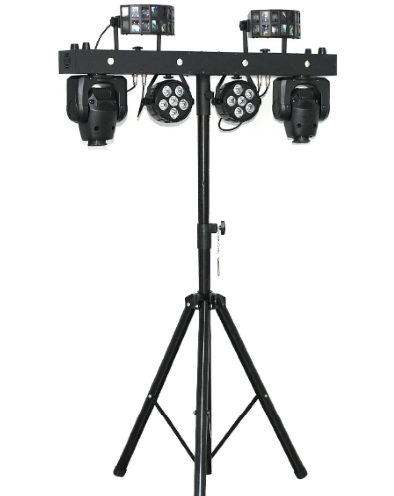
Most rental houses start by buying variety and end up owning a warehouse of fixtures that cannot be sent out together. The inventory that makes money is not the most impressive one; it is the one where any two units can be swapped into the same rig without a repatch, and where a single failure does not cancel the job.
The short answer
Buy two fixture types in quantity rather than five types in pairs: a small beam and a zoom wash, eight to twelve units in total. At EXW prices from US$96 to US$159 each, a ten-fixture starter fleet costs roughly US$1,100 to US$1,500 before cases and cabling, and it covers small club, bar, church and corporate work — the majority of a young rental house's booked jobs.
What fixture types cover most rental requests?
Four requests account for almost everything a small rental house is asked for, and two fixture types cover all four.
| The client asks for | What actually delivers it | Fixture type |
|---|---|---|
| Aerial beams, club punch | Narrow beam, high output per degree | Beam or mini beam |
| Colour wash over a stage | Wide, even field with zoom | Zoom wash |
| Front light on a performer | Narrow, even, gobo-capable | Spot (a wash with zoom often covers it) |
| Effects and movement | Position changes, colour changes | Either, if quantity is available |
The remaining requests — pixel-mapped walls, kinetic effects, lasers — need a different fixture family and a different programming skill. They are second-phase purchases, not starter stock.
Which beams and washes are worth buying?
These are real models with real EXW prices from our current range, chosen because they sit in the bands a new rental fleet can actually finance:
| Model | Class | Configuration | EXW, 1 unit | Volume |
|---|---|---|---|---|
| RG-ML150BR-KNNW1H13 | Mini beam | 1x150W | US$96 | US$90 over 30 pcs |
| RG-ML90WS-KCRe6AH11 | Wash | 6x15W | US$95 | US$88 over 50 pcs |
| RG-ML100BP-KNNW1H13 | Beam | 1x100W | US$105 | US$99 over 100 pcs |
| RG-ML285WD-KOSe19AH25 | Zoom wash | 19x15W | US$159 | US$149 over 20 pcs |
| RG-M230BN-KMH16 | Mini beam | 230W LED | US$179 | — |
| RG-ML300BR-KN1H17 | 3-in-1 BSW | 1x300W | US$315 | US$300 over 20 pcs |
Note the trap in that table: a 150W mini beam at US$96 and a 6×15W wash at US$95 are within a dollar of each other but do entirely different jobs, while a 3-in-1 BSW at US$315 does both from one unit. For a fleet, two matched sets at US$96 and US$95 are the stronger position: six beams and four washes covers more rigs than three BSWs ever will.
What does a ten-fixture starter fleet cost?
A defensible first order, built around two matched sets:
| Item | Qty | Unit EXW | Line total |
|---|---|---|---|
| Mini beam, 1x150W | 6 | US$96 | US$576 |
| Zoom wash, 19x15W | 4 | US$159 | US$636 |
| Fixtures subtotal | 10 | — | US$1,212 |
That excludes flight cases, clamps, cable and a controller — budget those as a second line, because a fixture without a case does not survive a season of rental. If the budget reaches further, the next dollar is better spent on two more washes than on one flagship BSW.
How should the fleet be standardised?
Standardisation is what turns a pile of fixtures into an asset:
- One channel footprint across the set, so a patch works whichever unit goes out.
- One clamp type and one safety bond, so prep is uniform.
- One case size, so the van load never needs re-planning.
- One spares bin — fuses, a spare fan, a spare set of gaskets and a spare power cable per fixture type.
- One firmware version, recorded, so a returned fixture is not subtly different from the rest.
A fleet where every unit is interchangeable can be sub-rented out whole and absorbed back without a patch change. A fleet of mixed models cannot.
Should the fleet be bought new or used?
New, for a first fleet, for three reasons: a warranty that covers the first season's failures, consistent firmware and colour across the set, and a supplier relationship you will need for spares. Used fixtures make sense later, when you already have a spares bin and in-house repair capability and know exactly which models your market rents.
The exception is a single hero fixture for a specific client's recurring show. That is a business decision about one contract, not an inventory decision about a fleet.
When should the inventory grow?
Add a third fixture type when a client asks for it by name and you have declined the job twice. Add quantity when you are turning work away or sub-renting in. Both signals are better than a specification upgrade, which changes the capability of one unit rather than the capacity of the fleet.
Our full moving head range covers everything from the eight-unit starter sets to BSW and pixel classes, and the rental inventory guide for 90 percent coverage continues the plan once the first fleet is earning.
How should the fleet be cased and stored?
Cases decide whether a fixture is still rentable after twenty jobs. Three rules cover most of it.
- One case per fixture, or one case per matched pair, sized so the clamp and safety bond travel with the fixture. A clamp that travels separately will eventually travel with the wrong fixture, or not return at all.
- Label the case outside with the model and an asset number, and the same number on the fixture. A fleet where the case number and fixture number disagree is a fleet that loses track of warranty dates.
- Store dry and off the floor. Moisture is what kills fixtures between jobs, and a garage floor in a humid month does more damage than a season of use.
Keep one spare case for every ten fixtures. Cases fail at the hinges and the wheels, and a fleet that cannot case a fixture cannot rent it.
What to send us
Tell us your three most common booking types — venue size, ceiling height and whether the job needs aerials or coverage — and the budget for the first order. We will return a matched quantity with tier pricing, a spares list and a case quantity, so the order arrives as a fleet rather than ten separate fixtures.
Frequently Asked Questions
What should a new rental house buy first?
Two types, in quantity: a small beam or mini beam for punch and aerials, and a zoom wash for coverage. Eight to twelve units of one type beats four types of two, because a rental client rents a look for a rig, and a look needs matched fixtures.
How many moving heads before a rental house can take club work?
Six matched units is the practical minimum. That covers a small stage front truss or a pair of side positions with spares, and it means one fixture failure does not cancel the look.
Is it cheaper to buy one expensive fixture or several cheap ones?
Several cheap ones, at first. In our range a mini beam is US$96 and a 300W 3-in-1 BSW is US$315. Three minis cover three positions; one BSW covers one. Rental income scales with matched units in service, not with the specification of the best fixture on the shelf.
How do I keep the fleet earning instead of sitting?
Standardise. One type of clamp, one type of case, one channel footprint and one spare-parts bin means a fixture can go out on any job without a new prep routine, and a sub-rental can blend into your fleet without a patch change.
When should a rental house add pixel fixtures?
When a client asks for a wall or a matrix by name, not before. Pixel bars are a different rental line, they need their own programming skill and they date faster than beam and wash fixtures.
Need help choosing fixtures for your project? Tell us the venue type and room size — we'll spec it for free.
Request a Free Rig Spec →