A permanent outdoor installation is the most expensive place to discover a specification was optimistic. Replacing a fixture on a roof costs several times the fixture, and doing it twice ends the project as a success story. Everything below is worth confirming in writing before the deposit.
The short answer
Verify six things in writing: how the IP rating was tested and on which assembly, how the yoke bearing and fan are sealed, whether the fixture is pressure-tested in production, the warranty terms including corrosion, which spares the factory stocks, and the volume tier thresholds for the quantities you are ordering. An unverified IP65 claim is a housing moulding, not a product specification.
How do I verify an IP claim rather than accept it?
Ask which test was run, on what, and for how long. A supplier who has really tested the fixture can describe the setup without looking it up; one who has not will describe the plastic.
| What was asked | Answer that satisfies | Answer that does not |
|---|---|---|
| Which unit was tested? | The assembled fixture, head and yoke fitted | The housing moulding, or a bare LED module |
| How was it tested? | Water jet test at stated pressure and duration | A visual check, or a rain simulation on a bare unit |
| Is it tested in production? | Sample or batch pressure test, stated interval | Not tested after the prototype |
| Which joints are sealed? | Named joints, with method | A general claim that the unit is sealed |
Two of these four questions will separate the field on their own.
What do the moving parts need to survive?
A moving head outdoors has three weak points that a static fixture does not: the yoke joint, the fan, and the cable entry. Each is a path for water and for the overnight moisture cycle, which does more cumulative damage than rain.
Ask specifically:
- How is the yoke bearing sealed, and can it be greased or replaced from outside?
- Where does the fan intake sit, and is it fitted with a moisture trap?
- Is the cable gland rated to the same IP as the housing?
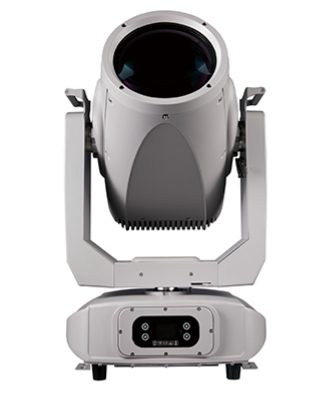
On a fixture like the 420W outdoor beam moving head, which people buy precisely because it lives outside for years, those three answers are the difference between a five-year fixture and a two-year one.
How should a sample be evaluated?
Evaluate at the throw distance you will actually use, and evaluate it hot. A showroom check at one metre tells you nothing about a 25 m throw or about how the beam behaves after two hours.
Run this sequence:
- Mount the sample at the intended throw distance and aim it.
- Record the beam at the two extremes of its zoom or angle range.
- Run it continuously for two hours and look at the beam, colour mixing and gobo edge again.
- Run a slow pan and tilt move and listen for bearing noise.
- Open the fixture and look at the gasket seat and the board coating.
If the sample is the only one you will ever get, this is the moment to spend a full day on it.
What commercial terms matter as much as the specification?
Commercial terms decide whether a good fixture is a good purchase.
| Model | Class | EXW, 1 unit | Volume tier | MOQ |
|---|---|---|---|---|
| RG-ML340WC-KCH37 | 6x40W outdoor moving head | US$185 | US$175 over 20 pcs | 20 |
| RG-ML760WC-KCH99 | 19x40W outdoor zoom wash | US$560 | US$530 over 20 pcs | 20 |
| RG-ML420WC-KCH93 | 7x60W outdoor moving head | US$590 | US$572 over 30 pcs | 30 |
| RG-M420BN-KH24 | 420W outdoor beam | US$757 | — | 1 |
The volume thresholds are low — 20 to 30 pieces — which means an installer running a single venue can often reach tier pricing on one order rather than staging it. Confirm which specific models carry a tier before you split an order across two types to hit a round number.
Also settle: the terms (EXW, FOB or CIF), the lead time in weeks, who owns the goods during transit, and what happens to a unit that fails in the first 30 days.
What must be confirmed before the first container?
A short checklist that prevents most of the expensive surprises:
- IP test evidence for the assembled unit, not the housing.
- Warranty in words, including whether corrosion is covered and what voids it.
- Spares list — gaskets, connectors, fans, bearings — with prices and lead times.
- Control integration — whether the protocol is DMX512, RDM or Art-Net, and what node is needed at the rig. A network to DMX converter at the truss is the usual answer.
- Voltage tolerance for long outdoor runs.
- Fixings and brackets in a material that will not corrode against your structure.
Any item without a written answer is a risk you are choosing to carry.
What should the quotation itself state?
A quotation you can compare against another one contains eight things. If any are missing, the comparison is guesswork.
- Model and configuration, unambiguously.
- IP rating, stated for the assembled fixture.
- EXW price per unit, and the volume tier thresholds.
- MOQ for that specific model.
- Terms — EXW, FOB or CIF — and who carries insurance in transit.
- Lead time in weeks from deposit.
- Warranty in words, including what voids it.
- Spares availability: which parts are stocked, at what price.
Two quotations that both list eight items can be compared in five minutes. Two that list a price and a picture cannot be compared at all, and the difference usually only appears when something fails in year two.
What to send us
Send the mounting positions, throw distances, the weather the position sees and the quantity, and we will return a quotation that states the IP rating of the assembled fixture, the sealed joints, the spares we stock and the tier price at your quantity. Compare that document against the next supplier's — the difference is usually not price, it is how much of the specification is actually verified.
Frequently Asked Questions
How do I know the IP65 claim was actually tested?
Ask which test was run and on what. A meaningful answer names the assembled unit, the test duration and the water pressure used. If the reply describes the housing moulding rather than the finished fixture, the rating applies to a part, not to the product you are buying.
What should a pre-shipment sample check?
Mount the sample and run it through a full show at the intended throw distance, then look at the beam, colour mixing and gobo edge again after two hours of continuous use. Geometry and colour shift with heat, and that is when a badly sealed or badly aligned unit shows itself.
Should I worry about MOQ on an outdoor install?
Yes, because volume tiers start lower than most buyers expect. In our range a 19x40W outdoor zoom wash drops from US$560 to US$530 at 20 pieces and a 7x60W outdoor head drops from US$590 to US$572 at 30 — worth knowing before you split an order across two models.
What control hardware does a permanent install need?
A network-to-DMX node at the rig rather than a long analogue run, so the control position can stay indoors. An Art-Net to DMX512 converter is the standard building block and sits around US$98 in our range.
Which parts should be stocked as spares?
Gaskets, sealed connectors, the fan and the yoke bearing. These are the parts that fail first outdoors, and any of them being unavailable turns a repair into a replacement.
Does a higher IP rating mean a longer warranty?
Not automatically. Warranty length and IP rating are separate promises; ask for the warranty in words, ask what it excludes, and ask whether corrosion is covered.
Need help choosing fixtures for your project? Tell us the venue type and room size — we'll spec it for free.
Request a Free Rig Spec →