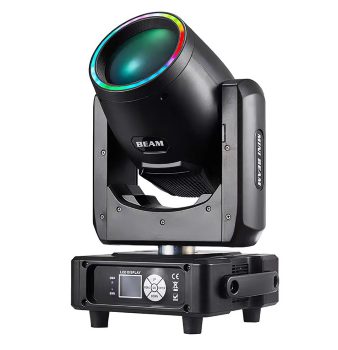
Beam angle and output are two critical factors in stage lighting that can affect the overall brightness and coverage of a light. For technicians and lighting designers, understanding the relationship between these two factors is essential for creating effective and engaging lighting designs.
The short answer
A 230W beam light can read brighter than a 400W wash light due to its narrower beam angle, which can be as low as 2-5 degrees, resulting in a higher intensity and brighter appearance.
What is beam angle and how does it affect output?
Beam angle refers to the angle at which a light emits its beam, measured in degrees. A narrower beam angle results in a more concentrated beam, which can appear brighter and more intense. The RG-M230BN-KMH16, for example, has a beam angle that can make it appear brighter than a wash light with a higher output.
How do I choose the right beam angle for my stage lighting needs?
To choose the right beam angle, consider the size of your stage, the distance between the light and the subject, and the desired level of brightness and coverage. A narrower beam angle is suitable for longer throws and smaller stages, while a wider beam angle is better for larger stages and shorter throws.
What are the key considerations when comparing beam and wash lights?
When comparing beam and wash lights, consider factors such as beam angle, output, color temperature, and dimming capabilities. Beam lights are often used for accent lighting and have a narrower beam angle, while wash lights are used for general illumination and have a wider beam angle.
How does the RG-M230BN-KMH16 compare to other beam lights on the market?
The RG-M230BN-KMH16 has a beam angle that can make it appear brighter than other beam lights on the market, including the RG-M230B-KOH20. However, the RG-M230B-KOH20 has a higher output and is suitable for larger stages and longer throws.
What are the advantages and disadvantages of using a beam light versus a wash light?
Beam lights are often used for accent lighting and have a narrower beam angle, resulting in a more concentrated beam. However, they can be more expensive than wash lights and may require more precise aiming and focusing. Wash lights, on the other hand, are used for general illumination and have a wider beam angle, resulting in a more even coverage. However, they can be less intense and may not be suitable for longer throws.
How do I determine the right size and configuration for my stage lighting system?
To determine the right size and configuration for your stage lighting system, consider factors such as the size of your stage, the type of performances or events you will be hosting, and the desired level of brightness and coverage. You may also want to consult with a lighting professional or use online tools and calculators to help you make an informed decision.
What are the different types of beam lights available on the market?
There are several types of beam lights available on the market, including the RG-M230BN-KMH16 and the RG-M230B-KOH20. Each type has its own unique characteristics, such as beam angle, output, and color temperature, and is suitable for different applications and uses.
How do I calculate the required output for my stage lighting system?
To calculate the required output for your stage lighting system, consider factors such as the size of your stage, the type of performances or events you will be hosting, and the desired level of brightness and coverage. You can use online tools and calculators to help you make an informed decision.
What are the benefits of using a beam light with a high output and narrow beam angle?
Using a beam light with a high output and narrow beam angle can result in a more intense and concentrated beam, which can be beneficial for accent lighting and longer throws. The RG-M230BN-KMH16, for example, has a beam angle that can make it appear brighter than a wash light with a higher output.
How do I compare the prices of different beam lights on the market?
To compare the prices of different beam lights on the market, consider factors such as the output, beam angle, and features of each light. The RG-M230BN-KMH16, for example, has an EXW price of $179, while the RG-M230B-KOH20 has an EXW price of $409.
| Model | Configuration | EXW Price | Volume Tier | MOQ |
|---|---|---|---|---|
| RG-M230BN-KMH16 | 230W beam moving head light | $179 | over 100 pcs | 100 |
| RG-M230B-KOH20 | 230W beam moving head light | $409 | over 10 pcs | 10 |
What are the different features and specifications of the RG-M230BN-KMH16 and RG-M230B-KOH20?
The RG-M230BN-KMH16 and RG-M230B-KOH20 have different features and specifications, including beam angle, output, and color temperature. The RG-M230BN-KMH16 has a beam angle that can make it appear brighter than a wash light with a higher output, while the RG-M230B-KOH20 has a higher output and is suitable for larger stages and longer throws.
You can find more information about the RG-M230BN-KMH16 and RG-M230B-KOH20 on our website. Next, review the specifications and features of each light to determine which one is best suited for your stage lighting needs.
What is the relationship between beam angle and output in stage lighting?
When choosing a beam light for your stage lighting needs, it's essential to consider the relationship between beam angle and output. A beam light with a narrow beam angle will produce a concentrated beam of light, but it may not be as bright as a light with a wider beam angle. On the other hand, a light with a wider beam angle will produce a more even and broader beam of light, but it may not be as focused as a light with a narrower beam angle. The key is to find a balance between the two, depending on your specific lighting needs. For example, if you're lighting a small stage, a light with a narrow beam angle may be sufficient, but if you're lighting a large stage, a light with a wider beam angle may be more effective. Additionally, the output of a beam light can also be affected by the type of LED used, the power consumption, and the overall design of the light. By considering these factors, you can choose a beam light that meets your specific needs and provides the desired output.
What the catalogue actually charges for these
| Model | Configuration | EXW |
|---|---|---|
| RG-CA8802 | 8 outputs | US$84 |
| RG-CA8402MINI | 4 outputs | US$51 |
| RG-CA8802PRO-A | 8 outputs | US$84 |
| RG-CA8402MINI | 4 outputs | US$51 |
| Model | Configuration | EXW |
|---|---|---|
| RG-ML108BR-KCRe9AH43 | 9*12W 4in1 | US$188 |
| RG-PDS56S36TB-V0 | 36 x15W 4in1 | US$125 |
| RG-M300BH-KYH16M | 16CH Beam moving head | US$205 |
| RG-CTD40S6F-K | LED Operator 3 Lighting Controller | US$49 |
Where to compare the models mentioned above
The two catalogue pages that carry the configurations in these tables are RG-M300BH-KYH16M and RG-CA8802PRO-A. Open each one for the full spec list, the volume tiers and the current EXW price.
Frequently Asked Questions
What is the relationship between beam angle and output in stage lighting?
The beam angle and output of a stage light are related but distinct factors that affect its overall brightness and coverage. A light with a narrower beam angle can appear brighter than one with a wider beam angle, even if the latter has a higher output.
How do I choose the right beam angle for my stage lighting needs?
To choose the right beam angle, consider the size of your stage, the distance between the light and the subject, and the desired level of brightness and coverage. A narrower beam angle is suitable for longer throws and smaller stages, while a wider beam angle is better for larger stages and shorter throws.
What are the key considerations when comparing beam and wash lights?
When comparing beam and wash lights, consider factors such as beam angle, output, color temperature, and dimming capabilities. Beam lights are often used for accent lighting and have a narrower beam angle, while wash lights are used for general illumination and have a wider beam angle.
Can a 230W beam light be brighter than a 400W wash light?
Yes, a 230W beam light can appear brighter than a 400W wash light if it has a narrower beam angle and is used for a longer throw or smaller stage. The RG-M230BN-KMH16, for example, has a beam angle that can make it appear brighter than a wash light with a higher output.
How do I determine the right size and configuration for my stage lighting system?
To determine the right size and configuration for your stage lighting system, consider factors such as the size of your stage, the type of performances or events you will be hosting, and the desired level of brightness and coverage. You may also want to consult with a lighting professional or use online tools and calculators to help you make an informed decision.
Need help choosing fixtures for your project? Tell us the venue type and room size — we'll spec it for free.
Request a Free Rig Spec →