The cost of a fixture is not what you pay for it; it is what it costs you every time someone has to climb to it. RDM exists to reduce those trips, and it does it using the cable you already run rather than an extra control system.
The short answer
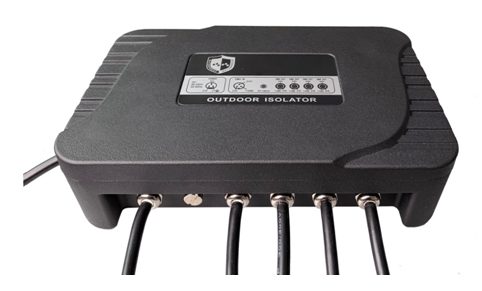
RDM is a two-way layer on the DMX512 line. It lets a compatible controller discover fixtures, read their status, reassign start addresses and identify a specific unit by flashing it — all from the desk. It needs an RDM-capable controller, an RDM-capable splitter or amplifier if the rig uses one, and correctly terminated DMX cable. A waterproof DMX512/RDM amplifier starts at US$98 EXW.
What does RDM do that plain DMX cannot?
DMX512 is a one-way broadcast: the controller sends 512 channel values and hears nothing back. RDM adds a request-and-reply conversation on the same pair, which turns the rig into something you can query.
| Task | Plain DMX | With RDM |
|---|---|---|
| Set a fixture's start address | Ladder, then fixture menu | From the controller |
| Confirm which unit is which | Aim it and watch | Flash the unit from the desk |
| Read lamp or LED hours | Not possible | Reported per fixture |
| Read internal temperature | Not possible | Reported per fixture |
| Find a faulting fixture | Walk the rig | Identify by address |
| Change a fixture's mode | Ladder, then fixture menu | From the controller, on supported models |
The last two rows are where RDM pays for itself on a touring rig: identifying a faulting fixture from the desk turns a 20-minute search into a two-minute one.
What hardware does an RDM rig need?
Four pieces, and only the first is mandatory.
| Model | Function | Key specifications | EXW, 1 unit |
|---|---|---|---|
| RG-CA8402A | DMX512/RDM amplifier, IP65 | 90-240V, 6W, 1.62 kg | US$98 |
| RG-CA8402MINI | DMX mini splitter | RS-485, XLR-3-M input, 90-240V | US$51 |
| RG-CS0302 | DMX512 mixer | merges or switches 3 console inputs | US$148 |
| RG-CR0CR021R | Art-Net / DMX512 network converter | 2 channels | US$98 |
- An RDM-capable controller. Without this nothing else matters.
- A splitter or amplifier that passes RDM. This is the piece people forget: a non-RDM splitter will happily pass control data and silently drop the reply.
- Correct DMX cable, terminated at the last fixture.
- Fixtures that support RDM, with the feature enabled in their menu.
If the rig already has a splitter that predates RDM, replacing it with the US$98 RDM amplifier is the entire upgrade.
Can I cut ladder time without RDM at all?
Yes, and it is often the cheaper first step. A rig where the fixtures sit above a stage and the ladder is the real cost will benefit from wireless DMX before it benefits from RDM, because the cable run is the thing that eats time on every load-in.
| Item | What it is | EXW, 1 unit |
|---|---|---|
| RG-CTCWIXLRR-RS | 2.4G wireless DMX512 receiver | US$25 |
| RG-CTCWILDR-RS | Wireless remote control | US$41 |
| RG-CTCWIPCB-RS | Wireless remote control PCB | US$15 |
The trade-off is real: 2.4G wireless removes a cable but adds a link that can be interrupted by interference. On a fixed install with a clean RF environment it is straightforward; on a busy convention floor, run the cable if you can.
How do I set RDM up on an existing rig?
Do it in this order and you will avoid most of the confusion:
- Confirm the controller supports RDM and has it enabled.
- Confirm every splitter or amplifier in the chain passes RDM.
- Terminate the last fixture on every output.
- Run discovery with the rig powered and idle — not during a show file.
- Compare the discovered list against your patch sheet and fix address clashes found.
- Record the device IDs alongside fixture numbers so the next discovery is instant.
Step 6 is the one that gets skipped and the one that makes RDM useful next season.
Why does RDM discovery fail?
Work down this list before assuming a faulty fixture:
- Non-RDM splitter in the signal path — the most common cause by a wide margin.
- No terminator on the final fixture of the output being scanned.
- Two fixtures on the same start address, which makes discovery ambiguous.
- A fixture with RDM disabled in its menu, often the default on delivery.
- A long unterminated stub feeding a single fixture off a splitter.
Scan one splitter output at a time with nothing else connected. The output that fails is where the problem is.
Is RDM worth it on a small rig?
On a fixed installation with ten fixtures in a ceiling, the answer is usually no — RDM saves ladder trips, and there are few to save. On a rig that gets built and struck repeatedly, or where fixtures sit in positions that need a lift to reach, the answer is yes at almost any quantity, because the saving compounds at every load-in.
The honest framing: RDM is a labour-saving purchase, not a capability purchase. It does not make the show look better. It makes the show get built faster and diagnosed sooner, which is what a rental house actually sells.
Does RDM replace the fixture's own menu?
No, and expecting it to is the most common disappointment. RDM covers addressing, mode selection on supported models, status readout and identification. It does not replace the fixture menu for firmware updates, calibration, or settings that the manufacturer did not expose over RDM.
Practically that means two habits stay in place:
- Keep the menu tree for each fixture type in the show folder, so a technician can change an unexposed setting without hunting for a manual.
- Check what a fixture exposes over RDM before you plan to manage it remotely. The feature list varies by model, and a fixture that reports temperature is not necessarily a fixture that accepts an address change.
RDM reduces ladder trips. It does not remove the need to know the fixture.
What to send us
Send your current signal chain — controller, splitters, number of fixtures per run and cable lengths — and we will tell you which piece needs replacing to make the rig RDM-capable, plus whether a wireless link is worth adding for your layout. The starting point is usually the DMX512/RDM amplifier replacing an older splitter, since everything upstream of it can stay exactly as it is.
Frequently Asked Questions
What does RDM actually do?
RDM is a two-way layer on top of DMX512. It lets a compatible controller discover fixtures on the line, read their status, change their start address and identify a specific unit by flashing it, all without a ladder. DMX itself only sends one-way control data.
Do I need special cable for RDM?
No, but you need cable that meets the DMX specification. RDM uses the same pair and the same impedance, so the failure mode is the same as DMX: a microphone cable or a long unterminated stub stops both signals. Terminate the last fixture as usual.
Why does RDM discovery miss fixtures?
Usually one of four things: the fixture is not RDM-capable, the splitter in the chain is a non-RDM type, the terminator is missing, or two fixtures share an address. Walk the chain with one fixture connected at a time to find which of them stops discovery.
Can I mix RDM and non-RDM fixtures on one line?
Yes. RDM is additive, so non-RDM fixtures simply stay invisible to discovery while still responding to DMX control. The only cost is that you cannot read their status remotely.
Is wireless DMX a substitute for RDM?
No, they solve different problems. Wireless removes the cable run; RDM removes the ladder trip. A rig can use either, both or neither, and the wireless receiver is the cheaper of the two to add.
Need help choosing fixtures for your project? Tell us the venue type and room size — we'll spec it for free.
Request a Free Rig Spec →