Understanding Power Requirements
When choosing a moving head, it's essential to consider the power requirements of your application. The wattage of a moving head determines its brightness and the distance it can illuminate. A higher wattage typically means a brighter beam, but it also increases the power consumption and heat generation.
Calculating Wattage Needs
To determine the required wattage, consider the following factors:
- Distance: The farther the beam needs to travel, the higher the wattage required.
- Ambient Light: If the area is well-lit, a lower wattage may be sufficient.
- Beam Angle: A narrower beam angle requires less wattage than a wider one.
For example, if you need to illuminate a stage with a beam angle of 10 degrees at a distance of 20 meters, a moving head with a wattage of at least 200W may be required.
Choosing the Right Moving Head
When selecting a moving head, consider the following wattage ranges:
- Low-wattage (50-100W): Suitable for small areas, such as bars or restaurants.
- Medium-wattage (100-200W): Ideal for medium-sized areas, like event spaces or small theaters.
- High-wattage (200-500W): Required for large areas, such as concert venues or large theaters.
Cabling and Daisy-Chaining
Cabling and daisy-chaining are critical aspects of moving head installations. Ensure that the cables are properly sized and rated for the power requirements of the moving heads.
When daisy-chaining moving heads, consider the following:
- Use a daisy-chain cable with a suitable gauge and length.
- Ensure that the daisy-chain cable is properly connected to the moving heads.
- Use a power conditioner or a daisy-chain controller to manage the power distribution.
Product Selection
Based on the wattage requirements, consider the following RiGeBa Lighting products:
- For low-wattage applications, the RG-ML80B-KCRe8AH38 (8x10W) or the RG-ML285WD-KOSe19AH25 (19x15W) may be suitable.
- For medium-wattage applications, the 6W Moving head full color laser (6W) or the New 295W 10R beam moving head (295W) may be required.
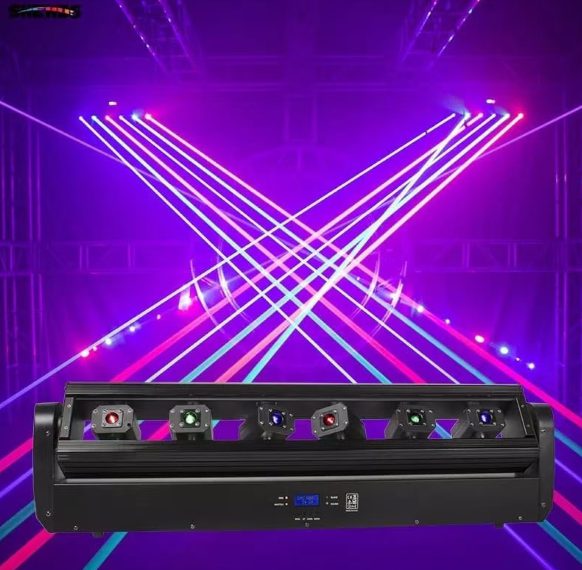
- For high-wattage applications, the 6 heads full-color swinging laser arrows moving head laser (3000mW) may be necessary.
Conclusion
When choosing a moving head, consider the power requirements of your application. Calculate the wattage needs based on the distance, ambient light, and beam angle. Select a moving head with a suitable wattage range and ensure proper cabling and daisy-chaining. By following these guidelines, you can avoid field-day disasters and ensure a successful moving head installation.
Need help choosing fixtures for your project? Tell us the venue type and room size — we'll spec it for free.
Request a Free Rig Spec →