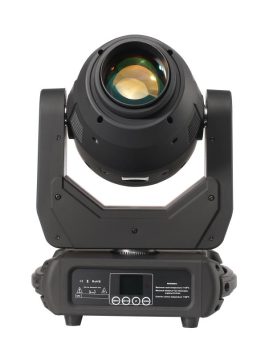
A small club is not a small version of a festival stage. The ceiling is 3 to 4 m, the throw distance is short, the room runs six nights a week, and nobody is looking up. Most moving-head advice assumes a 10 m trim and a haze machine, and following it produces a rig of narrow beams doing nothing in a low room.
The short answer
Buy washes and multi-beam bars, not narrow beams. At a 3.5 m trim a narrow beam has no distance to become a visible shaft, so the money is better spent on wide coverage, fast movement and colour. Four to six moving fixtures plus a fixed wash covers a 40 m² room, and the fixture budget lands between US$600 and US$1,300 at factory prices.
Why does ceiling height decide the fixture type?
A beam effect needs air. The shaft becomes visible because haze scatters light along a long path, and at 3 m of throw there is not enough path for that to happen. What you get instead is a small, very bright pool on the wall or floor.
| Ceiling / trim height | What works | What wastes money |
|---|---|---|
| Under 3 m | Wide washes, LED bars, static colour | Any beam fixture, any long-throw spot |
| 3–4.5 m | Zoom washes, multi-head beam bars, pixel bars | Dedicated 1°–3° beams |
| 4.5–6 m | Wash plus a few beams for aerial fans | Very narrow beams still marginal |
| Above 6 m | Beams earn their place | — |
The useful move at 3 to 4 m is a multi-head bar. Eight small beams sweeping across a dance floor from one rigging point reads as far more activity than one powerful beam, and it hangs from a single clamp.
| Model | Configuration | EXW, 1 unit |
|---|---|---|
| RG-ML70WS-KNNe7AH8 | Compact LED moving head | US$45 |
| RG-ML54WS-KEDf18AH12 | Compact LED moving head | US$49 |
| RG-ML100BD-KCRe5AH21 | LED beam, RGBW 4-in-1 | US$78 |
| RG-ML90WS-KCRe6AH11 | 6 × 15W beam | US$95 |
| RG-ML150BR-KNNW1H13 | Mini 150W | US$96 |
| RG-ML100BP-KNNW1H13 | 100W LED beam | US$105 |
| RG-ML80WN-KLEW8H12 | 8-head LED spider, CREE | US$115 |
| RG-ML80B-KCRe8AH38 | 8-head LED beam bar | US$134 |
The two 8-head units are the ones that make sense low. RG-ML80WN-KLEW8H12 gives eight individually aimable heads from one hanging point, and RG-ML80B-KCRe8AH38 is the beam-bar version of the same idea — eight narrow beams that sweep as a group.
How much should a club spend per fixture?
There is a floor below which a fixture will not survive nightly use. The sub-US$100 units in our range are honest, well-built small fixtures, but they are built for occasional work. A room running six nights a week should buy in the US$150 to US$220 band and hold two spares.
| Budget per fixture | What you get | Right for |
|---|---|---|
| Under US$100 | Compact LED moving heads, low output | Background accents, occasional use |
| US$100–US$180 | Mini beams, 8-head bars, 72 × 3W washes | Clubs running two or three nights a week |
| US$180–US$260 | Zoom washes, pixel washes, 200W+ beams | Clubs running nightly |
| US$260+ | CMY hybrids, IP65 units | Not usually justified in a small club |
| Model | Configuration | EXW, 1 unit |
|---|---|---|
| RG-ML216WD-KTXf72AH12 | 72 × 3W RGB wash | US$149 |
| RG-ML360WD-KTXe36AH12 | 36 × 10W 4-in-1 wash | US$139 |
| RG-ML285WD-KOSe19AH25 | 19 × 15W wash | US$159 |
| RG-ML125BL-KCRe38AH274 | 38 × 3W, infinite rotation | US$155 |
| RG-ML340WC-KCH37 | 6 × 40W RGBW pixel | US$185 |
| RG-ML350WR-KOSe4H58 | 7 × 40W zoom wash | US$186 |
| RG-ML108BR-KCRe9AH43 | 9 × 12W triangle spider | US$188 |
| RG-ML400BR-KCRe10AH49 | 10 × 40W RGBW pixel | US$199 |
For most clubs the sweet spot is the second and third rows. RG-ML350WR-KOSe4H58 is the one we recommend most often, because zoom means the same fixture works on the dance floor and on a small stage without refocusing.
What actually matters in a club specification?
Speed, colour change and noise — not raw output. At club distances every modern LED fixture is bright enough, so the specifications that change how the room feels are the ones buyers rarely compare.
| Specification | Why it matters in a club | What to look for |
|---|---|---|
| Pan/tilt speed | Fast movement is what reads as energy | Fastest available in budget; check the spec, not the brochure |
| Colour change speed | Slow colour wheels look sluggish on beat | LED RGBW over a mechanical wheel |
| Fan noise | A loud fixture is audible in a quiet bar | Ask for the dB figure at 1 m |
| Beam angle | Short throw needs wide coverage | 25°–60°, or a zoom |
| Dimming curve | Poor low-end dimming looks steppy | 16-bit dimming where offered |
How do you lay out four to six fixtures?
Put coverage first and movement second. Two fixtures overhead on the dance floor doing wide colour washes, two on the booth wall doing sweeps and effects, and two angled at the stage or DJ position for front light and specials.
| Position | Fixture type | Count | Job |
|---|---|---|---|
| Overhead, dance floor | Zoom wash | 2 | Colour coverage across the floor |
| Booth / back wall | 8-head bar or spider | 2 | Sweeping movement behind the DJ |
| Stage or DJ position | Wash or mini beam | 2 | Front light and occasional specials |
| Fixed, ceiling | LED PAR | 6–8 | Base colour wash that never moves |
The last row is the one that gets skipped. Movement is expensive per lumen; a fixed LED PAR delivers far more light per dollar and never needs focusing. A club with eight fixed PARs and six moving heads looks considerably better than one with twelve moving heads alone.
What should a club skip?
Narrow beams, IP65 fixtures, CMY colour mixing and anything above about 260W. All four are built for a job a small club does not have: long throw, weather, precise colour rendering, or a large stage. Indoor units are roughly half the price of their IP65 equivalents, and CMY adds cost that only pays off when you need to match a specific colour on camera.
If the room does have one beam-friendly position — a high corner with a long diagonal throw — one 200W beam is worth having for the moments when the room fills with haze. Otherwise spend the money on a wider wash.
Send us your room dimensions and ceiling height and we will put together a fixture count and a budget.
Frequently Asked Questions
Do beams work in a small club?
Only if the ceiling is above about 5 m and you run haze. Below that, a narrow beam lands as a hot dot on the back wall and does nothing for the room. A wide wash or a multi-beam bar gives you far more visible effect per dollar at 3 to 4 m.
How many moving heads does a 40 m² club need?
Four to six for movement, on top of a fixed wash. Two overhead on the dance floor, two on the booth or back wall, and two for the stage area. Movement is an accent; the coverage comes from cheaper fixed fixtures.
Is a cheap moving head reliable enough for a club that runs six nights a week?
The sub-US$100 units are built for light duty. For a room running nightly, budget US$150 to US$220 per fixture and keep two spares. The saving on the cheap units disappears the first time you lose a fixture on a Friday.
What matters more in a club: brightness or speed?
Speed. At club distances every modern LED unit is bright enough, so what the room notices is how fast the fixture moves and how quickly it changes colour. Pan and tilt speed is the specification that reads on a dance floor.
Should a club buy a hybrid 3-in-1 fixture?
Yes, if the rig is small. One fixture that can wash the floor and throw a pattern covers two looks from one rigging point, which matters when the ceiling only has four places to hang anything.
Need help choosing fixtures for your project? Tell us the venue type and room size — we'll spec it for free.
Request a Free Rig Spec →