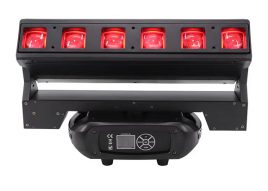
Beam, wash and hybrid are not three grades of the same product — they are three different jobs. A beam draws a visible shaft of light in the air. A wash puts an even field of colour onto a surface or a crowd. A hybrid does both plus a pattern, at a premium, with a little less of each. Buying the wrong one is the single most common reason a rig looks underpowered despite costing plenty.
The short answer
Buy washes for coverage, beams for aerial effect, and hybrids only when the fixture count or the truck space is the binding constraint. On a typical rig the wash count should outnumber the beam count by roughly two to one. If you can only buy one type, buy a wash: a room with even colour and no beams looks lit, while a room with beams and no wash looks half-finished.
What actually separates a beam from a wash?
The difference is beam angle, and everything else follows from it.
| Type | Typical beam angle | What it is for | What it looks like when it fails |
|---|---|---|---|
| Beam | 1°–5° | Visible shafts, aerial fan effects, punchy looks in haze | Nothing on stage — the beam misses the audience and only fills the air |
| Spot | 5°–20° | Gobos, prisms, a defined pool on a performer | Hard edges and hot centres where you wanted soft coverage |
| Wash | 15°–60° | Even colour across a stage, wall or crowd | Flat, washed-out looks with no shape or texture |
| Hybrid (BSW) | Zoom across the range | One fixture covering beam, spot and wash duties | Compromise at every setting — adequate everywhere, best nowhere |
A beam fixture is deliberately inefficient at lighting a stage. It concentrates output into a narrow column so the shaft is visible in haze, and that means the pool it lands on is small and hot. A wash spreads the same lumens over a much larger area, so the field is even and the shaft is invisible unless the air is thick.
When does a beam fixture earn its place?
When there is haze, a ceiling height of at least 5 m, and an audience that looks up. Beams are an aerial effect, and they need three-dimensional space to exist in. In a room with a 3 m ceiling and no haze, a beam gives you a bright dot on the far wall and nothing else.
Beams also carry furthest. A narrow beam holds its intensity over a long throw, which is why festival stages and large rooms use them for fan effects across the audience rather than for lighting the stage.
| Model | Type | EXW, 1 unit |
|---|---|---|
| RG-M230BN-KMH16 | Mini 230W beam | US$179 |
| RG-M200BN-KPH16 | 200W 5R beam | US$180 |
| RG-M300BH-KYH16M | 300W 16-channel beam | US$205 |
| RG-M280BH | 280W beam | US$269 |
| New 295W 10R beam moving head | 295W 10R beam | US$332 |
| RG-ML380BN-KYH20 | 380W beam | US$336 |
| RG-M350BH-KYH20 | 350W 17R beam | US$419 |
Browse the indoor beam moving head range or the IP65 outdoor beam range if the rig lives outside.
When is a wash the right buy?
Almost always, and usually first. A wash is what makes a stage look lit rather than spotted. It is also the fixture that scales: coverage is arithmetic, so you can work out how many you need from the width of the stage and the trim height.
Zoom is the option worth paying for. A wash at a fixed angle is only correct at one distance; move the trim by 2 m and the coverage changes enough to leave stripes on the floor. Zoom lets the same fixture cover a club stage one week and a 12 m festival stage the next.
| Model | Configuration | Zoom | EXW, 1 unit |
|---|---|---|---|
| RG-ML360WD-KTXe36AH12 | 36 × 10W 4-in-1 | No | US$139 |
| RG-ML285WD-KOSe19AH25 | 19 × 15W | No | US$159 |
| RG-ML350WR-KOSe4H58 | 7 × 40W RGBW Osram | Yes | US$186 |
| RG-ML600WR-KOSe12H58 | 12 × 40W RGBW Osram | Yes | US$315 |
| RG-ML500WR-KOSe4H93 | 7 × 60W RGBW Osram | Yes | US$390 |
| RG-ML760WC-KCH99 | 19 × 40W, IP65 | Yes | US$560 |
The jump from US$139 to US$186 buys zoom and Osram emitters. That is the best-value upgrade in the range, because it removes the constraint that otherwise forces you to buy two different wash angles.
Is a hybrid worth the premium?
A hybrid (beam–spot–wash, or BSW) makes sense when the fixture count is fixed by something other than budget: a truck that holds 40 fixtures, a ceiling with 24 rigging points, or a crew of two who can only focus so many units. In those cases one fixture doing three jobs beats three fixtures doing one.
It makes less sense when you already know the job. A rig that is 90% wash does not benefit from paying for beam optics it will rarely use, and a dedicated beam will always throw a tighter, brighter shaft than a hybrid set to beam mode.
| Model | Configuration | EXW, 1 unit |
|---|---|---|
| RG-ML300BR-KN1H17 | 300W 3-in-1 BSW | US$315 |
| RG-ML250BR-KN1H18 | 250W LED zoom 3-in-1 | US$359 |
| RG-ML400RS-KNNW1H21 | 400W CMY 3-in-1 BSW | US$459 |
| RG-ML350BR-KN1H18 | 350W 3-in-1 | US$465 |
| RG-ML500RS-KNNW1H20 | 500W CMY 3-in-1 BSW | US$569 |
| RG-M380B-KOH16 | 380W IP65 beam-spot-wash | US$715 |
The 400W and 500W RS models add CMY colour mixing, which is what makes a hybrid usable as a genuine spot fixture rather than a beam with extra glass. CMY is the difference between a hybrid that can hold a stage look and one that only does effects.
How should a rig split across the three types?
Count washes first, because coverage is a number you can work out. Take the stage width, divide by the coverage width of your wash at its trim height, and add 20% for overlap. Then add beams for aerial work — four to eight is usually plenty — and use hybrids only where a position has to serve two purposes.
| Venue | Wash | Beam | Hybrid | Why |
|---|---|---|---|---|
| Club, 6 m stage, low ceiling | 8 | 2 | 0 | No height for aerial work; coverage and colour are the whole job |
| Church sanctuary, 8 m trim | 6 | 0 | 4 | Front light from white washes, movement from a few quiet hybrids |
| Touring rig, 12 m stage | 16 | 8 | 6 | Enough height for beams; hybrids cover specials |
| Festival stage, IP65 | 10 | 6 | 4 | Outdoor units cost roughly double, so the count stays lean |
The outdoor row is worth dwelling on. Because a weatherproof moving head costs roughly twice its indoor equivalent, outdoor rigs are nearly always built with fewer, better fixtures. Sealing the housing, gasketing every connector and giving the enclosure a drainage path costs real money, and the price ladder shows it: indoor beams start at US$180 while the IP65 range starts at US$409.
Which should you buy first?
A zoom wash, then a beam, then — only if the fixture count is constrained — a hybrid. Working outward from coverage is what keeps a modest budget looking deliberate. Working inward from effects is what produces a rig of eight beams lighting a dark room.
Send us the stage width, trim height and ceiling height and we will size the wash count and the beam count for your room.
Frequently Asked Questions
What is the difference between a beam and a wash moving head?
A beam makes a narrow, hard-edged shaft of light — typically under 5 degrees, built to be seen in the air. A wash makes a wide, soft-edged field, usually 15 to 60 degrees, built to put even colour on a surface or a crowd. One is an aerial effect, the other is a coverage tool.
Is a hybrid moving head as good as a dedicated beam?
Not quite. A hybrid that does beam, spot and wash trades some beam punch for the extra optics, so a dedicated beam usually throws a tighter, brighter shaft. What the hybrid buys you is one fixture doing three jobs, which matters more than peak punch when the truck is small.
How many wash fixtures does a rig need compared to beams?
More washes. Coverage scales with area, so a 12 m stage needs roughly one wash per 1.5 to 2 m of width, while four to eight beams are usually enough for aerial work. A common split on a mid-size rental rig is two-thirds wash and one-third beam.
Does a wash need a zoom?
A zoom is worth paying for if the trim height changes between jobs. A fixed 25-degree wash is fine at one distance and wrong at every other. Our zoom washes start at US$186, against US$139 for the fixed-angle version of the same fixture family.
Which moving head should a small venue buy first?
A wash, then a beam. A wash covers the room and makes the space look lit; a beam makes a moment. Buying four beams and no wash leaves a room with dramatic shafts of light and dark walls.
Are outdoor beam fixtures much more expensive?
Roughly double. Sealing a moving head against weather adds housing, gasketed connectors and a drainage path, and our IP65 beams start at US$409 against US$180 for a comparable indoor unit.
Need help choosing fixtures for your project? Tell us the venue type and room size — we'll spec it for free.
Request a Free Rig Spec →