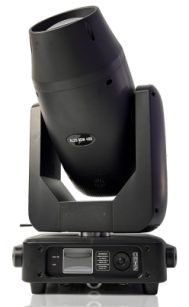
Most moving head spec sheets are written to be impressive rather than useful. They lead with a wattage, bury the two figures that decide everything — beam angle and lux at a stated distance — and omit the one number a buyer actually needs: what the fixture costs at the quantities you are ordering. This guide is the version we give distributors: which numbers to trust, which to distrust, and what those numbers mean in money.
The short answer
To compare two moving heads, ask for five figures: beam angle, lux at a stated distance, LED configuration (how many sources, and at what wattage each), pan and tilt range, and IP rating. Compare them at the same distance and the same beam angle. Everything else on the sheet — wattage, "high brightness", model numbers — is decoration. Then ask for the EXW price at your order quantity, because two fixtures with identical wattage can differ in price by more than 2×.
Why does the wattage on the box tell you almost nothing?
Watts measure how much electrical power a fixture draws. They do not measure light output, colour quality, or build quality.
Our own catalogue makes the point better than any explanation. Both of these are 150W LED moving heads:
| Model | Class | LED configuration | EXW, 1 unit |
|---|---|---|---|
| RG-ML150BR-KNNW1H13 | Mini beam | 1×150W | US$96 |
| RG-ML150BR-KNNW1H16 | White beam | 1×150W | US$258 |
Identical rated power, 2.7× the price. The difference is in the parts the wattage figure hides: LED bin and colour consistency, the lens and optical train, how the fixture mixes colour, the housing and the cooling design that decides whether it still performs in year three. A buyer who shops by wattage will pay the same money for a much weaker fixture — or refuse to pay for a better one because "it's also just 150W".
The reverse trap is also real. A 200W discharge (5R) Sharpy-style beam and a 200W LED beam are not interchangeable, and the older technology is not automatically cheaper:
| Model | Light source | EXW, 1 unit |
|---|---|---|
| RG-M200BN-KPH16 | 200W 5R discharge, beam | US$180 |
| RG-M230BN-KMH16 | 230W LED, mini beam | US$179 |
Lumens or lux — which one should I ask for?
Ask for lux at a distance, and only compare two fixtures at the same distance and the same beam angle.
- Lumens is total light emitted, summed in every direction. It is a useful headline and a terrible comparison tool, because it says nothing about how the fixture concentrates that light.
- Lux is illuminance on a surface — how much light actually lands on the stage, the wall, or the performer. It is the number that decides whether the fixture is bright enough.
The reason beam angle matters so much is geometry. Halve the beam angle and you concentrate the same lumens into roughly a quarter of the area, so lux at any distance goes up about fourfold. Double the beam angle and lux falls to about a quarter. This is why a 150W narrow beam can look brighter on a performer than a 500W wash does — and why a spec sheet that lists lumens but not beam angle has told you nothing you can act on.
The same relationship governs throw distance. Illuminance falls with the square of the distance: a fixture that gives 10,000 lux at 5 m gives roughly 2,500 lux at 10 m. If a supplier quotes lux without quoting the distance, treat the number as marketing.
What does LED configuration actually tell you?
"LED configuration" is written as sources × wattage per source — 1×400W, 12×40W, 19×40W. It tells you whether the fixture is a single-source light or a multi-source array, which is the difference between a beam/spots fixture and a pixel/eye-candy fixture.
Both of these draw 400W in total. They are not competitors:
| Model | Configuration | What it is for | EXW, 1 unit |
|---|---|---|---|
| RG-ML400BR-KCRe10AH49 | 10×40W RGBW 4-in-1 | Pixel bar, matrix effects, beams and sweeps | US$199 |
| RG-ML400RS-KNNW1H21 | 1×400W with CMY | 3-in-1 beam / spot / wash, gobo work, long throw | US$459 |
The pixel bar wins on visual impact per dollar for a club or a bar wall. The single-source BSW wins when you need one controllable beam with colour mixing, gobos and a clean edge. Buying the pixel bar for a theatre front-of-house position, or the BSW for a pixel-mapped club ceiling, is how rigs end up disappointing people who spent real money.
Which fixture class do I need before I read the numbers?
Four classes cover almost every moving head purchase. Knowing which one you need eliminates most of the spec sheet before you read it:
| Class | Beam angle behaviour | Typical use |
|---|---|---|
| Beam | Very narrow, fixed or lightly variable | Aerials, punches through haze, long throws |
| Spot | Narrow to medium, with gobos | Front light, pattern projection, key light |
| Wash | Wide, soft edge, often zoom | Colour coverage, stage wash, audience |
| Hybrid / 3-in-1 (BSW) | Wide zoom range covering beam to wash | One fixture that does everything — at a price |
A hybrid costs more because it has to be good at everything: more zoom mechanism, more optics, more alignment work in production. That is why a single-source 400W BSW sits at US$459 in our catalogue while a 10×40W pixel bar of the same total wattage sits at US$199.
What do moving heads actually cost, EXW Guangzhou?
These are real prices from our current catalogue — EXW Guangzhou in USD, single-unit and volume tiers where a tier exists. Prices move with LED and driver cost, so always re-quote, but the shape of the ladder is stable and worth understanding before you budget.
| Model | Class | Configuration | EXW, 1 unit | Volume |
|---|---|---|---|---|
| RG-ML150BR-KNNW1H13 | Mini beam | 1×150W | US$96 | — |
| RG-ML100BP-KNNW1H13 | Beam | 1×100W | US$105 | — |
| RG-M230BN-KMH16 | Mini beam | 230W | US$179 | — |
| RG-M200BN-KPH16 | Beam (5R) | 200W discharge | US$180 | — |
| RG-ML340WC-KCH37 | Outdoor pixel (IP65) | 6×40W RGBW | US$185 | US$175 over 20 pcs |
| RG-ML400BR-KCRe10AH49 | Pixel bar | 10×40W RGBW 4-in-1 | US$199 | US$186 over 30 pcs |
| RG-ML150BR-KNNW1H16 | White beam | 1×150W | US$258 | — |
| RG-ML300BR-KN1H17 | 3-in-1 BSW | 1×300W | US$315 | US$300 over 20 pcs |
| RG-ML500BL-KCRe12AH194 | Zoom wash | 12×40W | US$325 | US$290 over 50 pcs |
| RG-ML400RS-KNNW1H21 | 3-in-1 BSW + CMY | 1×400W | US$459 | — |
| RG-ML720BL-KCRe12AH179 | Wave bar | 12×60W RGBW | US$470 | US$455 over 30 pcs |
| RG-ML760WC-KCH99 | Outdoor zoom (IP65) | 19×40W | US$560 | US$530 over 20 pcs |
| RG-ML500RS-KNNW1H20 | 3-in-1 BSW + CMY | 1×500W | US$569 | — |
| RG-ML420WC-KCH93 | Outdoor (IP65) | 7×60W | US$590 | US$572 over 30 pcs |
| RG-M420BN-KH24 | Outdoor beam (IP65) | 420W | US$757 | — |
How to read this table:
- Under US$200 buys a working fixture — a mini beam, a single-source 100–230W beam, or a pixel bar. This is the band for bars, small clubs, churches and rental stock that needs numbers on the shelf rather than prestige.
- US$250–350 is where single-source output and zoom mechanisms start. You are paying for optics and mechanism, not for watts.
- US$450–600 is the BSW/CMY band: colour mixing, wide zoom, gobo wheels, and the alignment labour that makes them work.
- US$700+ is outdoor. The IP65 housing, sealing and testing add real cost, and a 420W outdoor beam sits well above every indoor fixture of similar output.
Two things to notice about the tiers: they are small — typically 3–8% for a 20- to 50-piece order — and the quantity threshold varies by model. If you are buying 30 pieces, it is worth asking which specific models have a 20-piece tier, because that can be the difference between paying list and paying volume.
What should I verify about pan and tilt?
Pan and tilt ranges are usually quoted as 540° pan and 270° tilt on a standard head, or 630°/270° on an "unlimited pan" model. What matters in practice:
- Pan range decides whether you can swing a fixture between two positions on one truss. 540° covers most positions; 360° models will need a re-aim rather than a sweep.
- 16-bit pan/tilt resolution (finer stepping) matters at long throw, where 8-bit movement is visible as a stutter on slow fades.
- Speed is quoted as a time or as degrees per second — and it is measured unloaded. Ask for the figure with the fixture carrying its own weight in gobos and prisms, or treat the number as optimistic.
Also check noise if the fixtures sit above an audience, CRI if cameras or skin tones are involved, and voltage range if the rig travels.
What are the red flags on a moving head spec sheet?
- Lux quoted with no distance. Meaningless. Ask for lux at 5 m or 10 m.
- Lumens at maximum output only. Many LED fixtures drop output when all colour channels are engaged. Ask for the wash-state figure.
- "IP65" with no mention of the head. A water-resistant housing with an exposed bearing or an unsealed yoke is not an outdoor fixture.
- No DMX channel list. You cannot plan a patch around "16/24/32 channels" without knowing which function sits on which channel.
- A price with no MOQ. MOQ is half the commercial reality of a quotation.
What should I demand in writing before I order?
- Beam angle and the measured lux at your actual throw distance.
- The full DMX channel list, in each mode the fixture supports.
- LED configuration, and the LED bin or colour-consistency guarantee.
- Weight and dimensions of the packed unit, for freight.
- MOQ, the volume-price thresholds, and the terms (EXW, FOB or CIF).
- Warranty coverage in words, and which spare parts the factory stocks.
A supplier who will put those six items in a quotation is a supplier you can compare with another. One who answers with a wattage and a picture is not.
If you are at the stage of comparing specific models, send us the beam angle, throw distance and quantity for your project and we will quote the two or three fixtures from our range that actually fit — plus the DMX channel list for each, so you can plan the patch before the order.
Frequently Asked Questions
Why does a 150W moving head cost US$96 while another 150W model costs US$258?
Wattage measures how much power a fixture draws, not how much light it delivers or how well it is built. The two 150W models in our catalogue differ in LED bin, lens and optical train, colour mixing system, housing and cooling design. Compare lux at a stated distance, not watts.
Should I compare fixtures by lumens or by lux?
Lux, and only at a distance you intend to use. Lumens is total light emitted in every direction; lux is illuminance on a surface. A fixture's lumen figure says nothing about how bright the beam looks at 8 m, because that depends on beam angle. Doubling the distance quarters the lux.
How many DMX channels does a moving head need?
A basic 16-channel head fits easily into one 512-channel universe, and 16-bit pan/tilt or CMY plus gobo and prism rotation can push a fixture to 24-40 channels. Divide 512 by the footprint to size the universe — with a 32-channel footprint you can run 16 fixtures per universe before you need a splitter.
What IP rating do I need for an outdoor moving head?
IP65 is the workable minimum for permanent outdoor installation — dust-tight and protected against water jets, so rain and washdown are survivable. IP54 covers splash only. Check the rating applies to the head and yoke as assembled, not just the housing.
Does a higher price always mean a better fixture?
No, it means a different fixture. A 10x40W pixel moving bar costs far less than a single-source 400W BSW, and each is the better buy in its own class: the pixel bar for matrix effects, the BSW for wash, gobo work and long throws.
Need help choosing fixtures for your project? Tell us the venue type and room size — we'll spec it for free.
Request a Free Rig Spec →