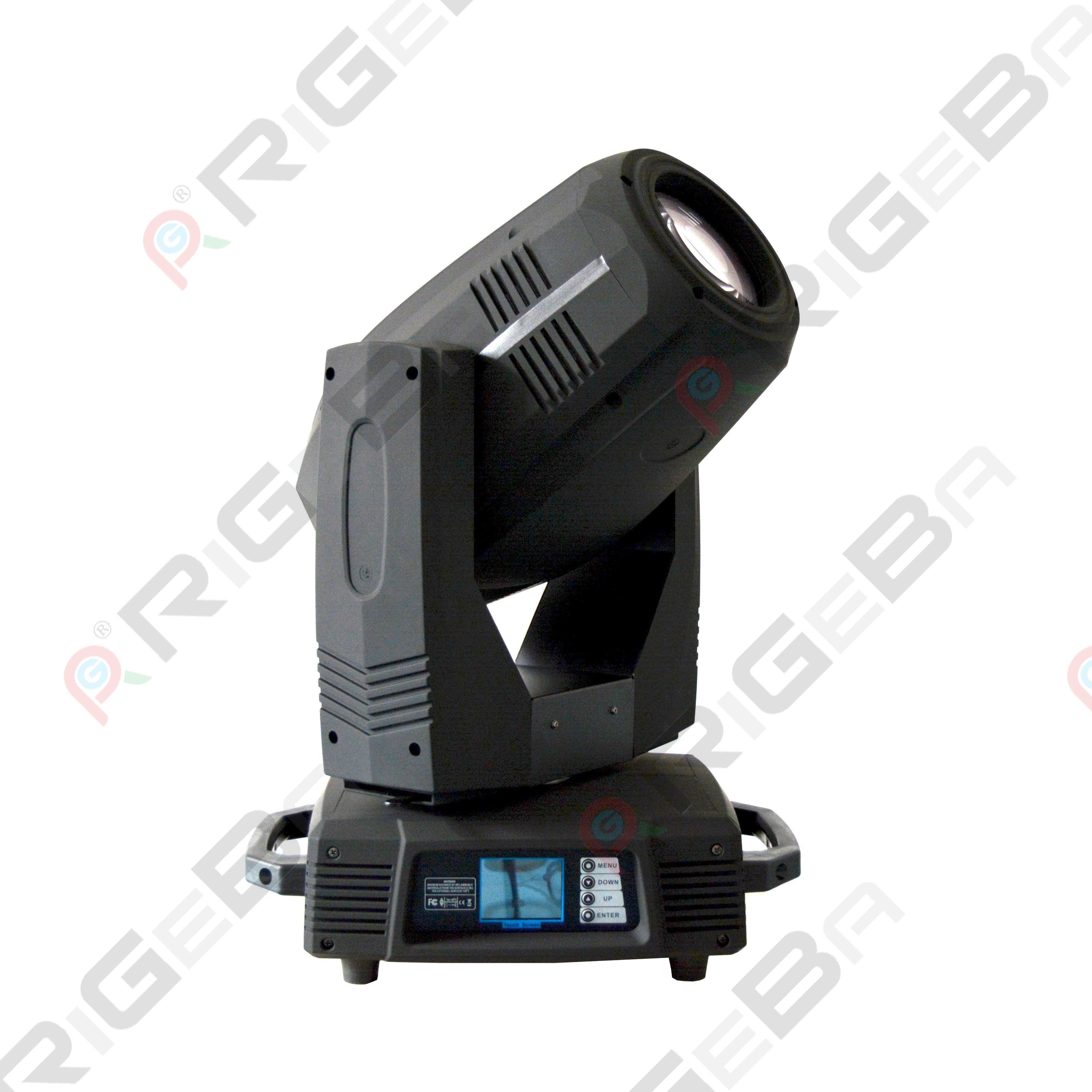
Ask three lighting designers which moving head to buy and you will get three answers, usually along the lines of "it depends". It does depend — but on things you can actually pin down. Here is how the three types differ in the specifications, and what each one costs you in practice.
The Short Answer
| Type | Beam angle range | Colour system | Best at |
|---|---|---|---|
| Beam | 1.8°–4.5° | Colour wheel | Visible aerial shafts, hard-edged effects |
| Wash | 4°–60° | RGBW / CTO | Even coverage, skin tones, camera work |
| Hybrid | 1.5°–50° | Colour wheel or CMY | One inventory covering both jobs |
Those ranges are not marketing copy — they are the actual zoom ranges across our current line-up. The overlap is the interesting part, and we come back to it.
Beam: When You Want to See the Air
Beam fixtures make the light itself the subject. They work at very narrow angles — our range runs from 2.0°–4.0° on the SL-B150 up to 1.8°–3.5° on the SL-B600 — and they are what produce the hard, defined shafts you see in concert photography.
What you give up is coverage. A 2° beam does almost nothing to light a performer's face; it lights dust and haze. Beam fixtures are an effect layer, not a key light.
Practical notes:
- They need atmosphere. Without haze, a beam fixture looks like a dim spotlight.
- Colour comes from a wheel, so changes are instant rather than smooth. That suits beam work — you want snap, not a fade.
- Narrow optics are unforgiving of cheap glass. This is where the price difference between brands actually shows.
Our beam range runs from 150W to 600W. Above 400W, models add Art-Net alongside DMX512 and RDM, which matters if you are running large rigs over network infrastructure.
Wash: When the Stage Needs to Be Lit
Wash fixtures do the opposite job: cover an area evenly. The zoom ranges are wide — 7°–55° on the SL-W200, 4°–60° on the SL-W600 — which means one fixture can work as a front wash from a short throw or as a backlight from a long one.
The colour system is the real difference here. Wash fixtures use RGBW mixing, with CTO correction on the 400W and 600W models. That gives you the tunable whites you need for camera work, which a colour wheel cannot deliver. If there is a camera on the stage, wash is not optional.
Two things buyers underestimate:
- Evenness matters more than output. A wash with hot spots is a wash you have to diffuse, and diffusion eats your output.
- Smooth dimming at the bottom of the curve. Every fixture in our range offers 0–100% linear 16-bit dimming. Cheaper fixtures step visibly below 10%, which is exactly where slow fades live.
Hybrid: The Rental-House Calculation
Hybrid fixtures zoom across both territories. Our SL-H280 covers 2.5°–35°, the SL-H400 2°–40°, and the SL-H800 spans 1.5°–50° — a wider total range than most dedicated beam or wash fixtures manage individually.
On paper that makes dedicated fixtures look redundant. In practice it is a trade, and rental houses understand it best:
| What you gain | What it costs you |
|---|---|
| One fixture covers two jobs | Higher unit price than an equivalent beam |
| Fewer SKUs, one spare-parts pool | More optics in the path — more to align, more to fail |
| Smaller inventory, simpler trucking | Heavier head, more rigging time per unit |
| Flexibility when a show changes | Optical compromise at both extremes |
For a rental house, the third row is usually decisive: a fleet of hybrids means one spare-parts inventory and a crew that knows one fixture. For a fixed installation with a known design, dedicated fixtures are usually cheaper and optically better.
What "16-Bit" Actually Costs You in Channels
Worth clearing up, because it catches people out when budgeting console capacity: 16-bit means two DMX channels per parameter, not one. A 16-bit pan uses a coarse channel plus a fine channel; same for tilt and dimming. That is why our moving heads offer selectable 16 / 20 / 24 channel modes — the larger modes allocate the fine channels that give you smooth movement and fades instead of visible stepping.
Budget console capacity on the mode you will actually use, not the smallest one.
A Practical Way to Decide
Work through these in order:
- Is there a camera? If yes, you need wash fixtures with CTO. Non-negotiable.
- Do you need visible beams in the air? If yes, add beam fixtures — and budget for haze.
- Is the design fixed or does it change? Fixed installation favours dedicated fixtures; changing designs favour hybrid.
- Are you holding inventory? If yes, count SKUs and spare parts, not just unit price. That is usually where hybrids win.
- What is your throw distance? Match zoom range to it. A fixture that cannot zoom wide enough will force you to hang it further away than the truss allows.
Next Step
Tell us the venue type, throw distance and whether the rig is touring or permanent, and we will come back with a fixture count, photometric files and a quote. Every unit ships with a 48-hour burn-in record, individual QC report and IES/LDT files so your team can pre-visualise before load-in.
Request a quote with your rig details, or ask our assistant on any product page for specifications.
Need help choosing fixtures for your project? Tell us the venue type and room size — we'll spec it for free.
Request a Free Rig Spec →